






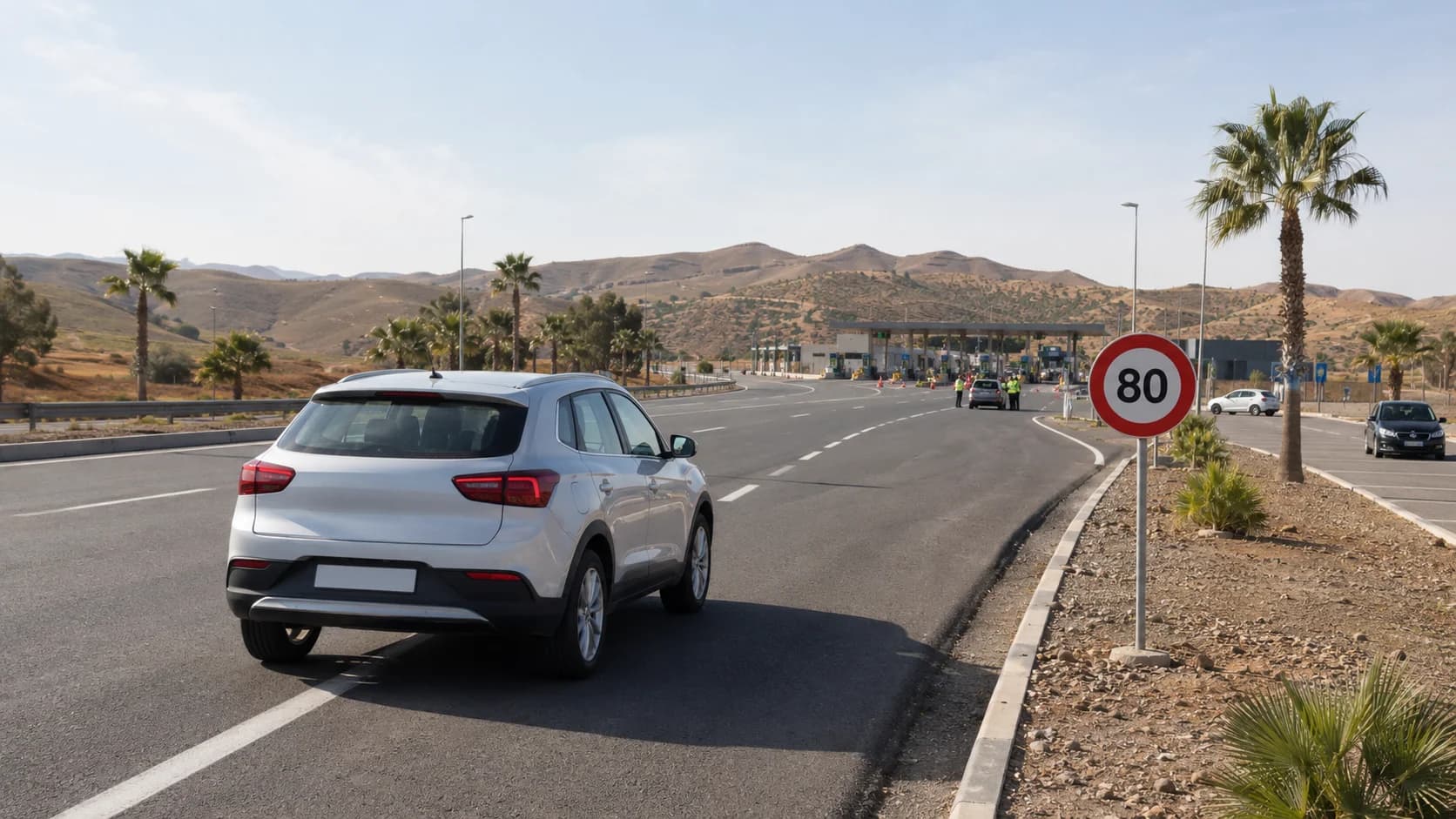
Driving in Morocco in 2026 is straightforward once you understand how the country's road system works. For tourists, the most important points are the posted speed limit, frequent changes in speed when entering towns, police and gendarmerie checkpoints, local parking restrictions and toll payments on the motorway network.
Morocco has approximately 1,800 km of motorways operated by Autoroutes du Maroc, connecting many of the country's major cities, ports, airports and economic areas.
This Morocco driving guide 2026 explains what to expect before taking a rental car onto roads around Casablanca, Marrakech, Rabat, Tangier, Fes, Agadir and the rest of the country.
What Should Tourists Know About Driving in Morocco?
For a normal passenger car, the commonly applicable maximum limits are 120 km/h on motorways, 100 km/h outside built-up areas and 60 km/h in built-up areas, unless a road sign sets a different limit.
Police checks and speed enforcement are common, particularly around town entrances, major roads and other controlled areas. Drivers should slow down early, follow an officer's instructions and keep their driving documents accessible.
Moroccan motorways are generally tolled. Autoroutes du Maroc currently accepts Jawaz electronic toll payment, bank cards, network cards and cash at toll stations.
For parking, follow the signs, meters and restrictions at the exact street or parking facility rather than assuming that one curb-color convention applies everywhere.
Driving in Morocco at a Glance
| Topic | What Drivers Should Know |
|---|---|
| Motorway speed | Up to 120 km/h unless signed otherwise |
| Roads outside towns | Common maximum of 100 km/h unless signed otherwise |
| Built-up areas | Common maximum of 60 km/h, with lower posted limits possible |
| Speed enforcement | Fixed/mobile enforcement and police controls may be encountered |
| Motorway tolls | Charged on much of the ADM motorway network |
| Toll payment | Cash, bank card, Jawaz and supported network cards |
| Parking | Check local signs, meters and restrictions |
| Motorway operator | Autoroutes du Maroc (ADM) |
| Motorway network | Approximately 1,800 km |
| Main driving advice | Follow the posted sign, even when it is lower than the general limit |
The posted sign should always be treated as the practical limit for the road you are driving on. Speed restrictions can change quickly as a road approaches a town, junction, construction area or other controlled section.
Table of Contents
- Morocco speed limits in 2026
- How speed-limit changes work
- Police checkpoints and what to do
- Speed cameras and enforcement
- Parking in Moroccan cities
- Parking near medinas and hotels
- Morocco motorway tolls
- How to pay tolls
- Main motorway routes
- Long-distance driving
- Common tourist driving mistakes
- Frequently asked questions
What Are the Speed Limits in Morocco in 2026?
For ordinary passenger cars, the general limits travelers will most commonly encounter are:
-
120 km/h on motorways
-
100 km/h on roads outside built-up areas
-
60 km/h in built-up areas
These figures are general maximum limits, not permission to maintain that speed everywhere. A lower speed displayed on a road sign takes priority.
This distinction is particularly important for tourists because the same journey can move through several speed environments within a short distance.
A road may begin as a fast intercity route, enter a settlement with a substantially lower limit and then return to a higher limit outside the built-up area.
Morocco Speed Limits Table
| Road Environment | General Maximum for Passenger Cars |
|---|---|
| Motorway | 120 km/h |
| Outside built-up areas | 100 km/h |
| Built-up area | 60 km/h |
| Locally restricted section | Follow the posted limit |
ADM itself describes the Moroccan motorway system as infrastructure designed for travel at up to 120 km/h, subject to safety conditions and road signs.
Why Tourists Get Caught by Changing Speed Limits
One of the easiest mistakes to make while driving in Morocco is concentrating on the general national limit rather than the current sign.
Imagine driving on an open road at 100 km/h. As the road approaches a town, the permitted speed may fall. A further restriction may appear around a junction, school, busy commercial area or roadworks.
The correct sequence is therefore:
Read the next sign → reduce speed before the restricted section → maintain the posted limit → wait for a new sign before increasing speed.
Do not assume that leaving a dense group of buildings automatically restores the previous speed.
This simple habit is more useful than trying to memorize every possible local limit.
Are There Speed Cameras in Morocco?
Yes. Drivers should expect speed enforcement in Morocco, including fixed and mobile controls. Avis' Morocco driving guidance specifically warns drivers that both mobile police speed traps and fixed speed cameras are common.
For visitors, the practical rule is simple:
Do not drive according to where you think a radar might be. Drive according to the speed limit.
Enforcement can occur on roads that appear open and uncongested, as well as near settlements.
A clear 100 km/h road can become a lower-speed approach to a town surprisingly quickly.
What Are Police Checkpoints Like in Morocco?
Police and gendarmerie road checks are a normal part of driving in Morocco.
They are often encountered on major routes and around entrances or exits to towns. Travel-driving accounts consistently report controlled roadblocks where drivers slow down, wait for an officer's instruction and may be asked for documentation.
A checkpoint does not automatically mean there is a problem.
What Should You Do at a Morocco Police Checkpoint?
When approaching a checkpoint:
-
Reduce your speed early.
-
Watch the officer and road signals.
-
Stop if instructed.
-
Stay calm and keep the vehicle under control.
-
Provide requested driving or vehicle documents.
-
Continue only when directed.
If you are driving a rental car, keep your driving licence and rental documentation readily accessible.
The important point is to respond to the checkpoint itself rather than copying what another vehicle does.
Should You Stop at Every Police Checkpoint?
Follow the officer's signal.
Some traffic may be allowed through while other vehicles are stopped. Do not automatically continue because the car in front of you was waved through.
Equally, do not stop abruptly in a live traffic lane unless instructed or unless traffic ahead requires it.
Approach slowly enough that you can clearly understand the signal being given.
What Documents Should Rental-Car Drivers Keep With Them?
Tourists should keep the original driving licence required for their rental, their rental agreement and other documentation supplied with the vehicle accessible while driving.
Requirements can depend on the traveller's licence and rental conditions, so confirm the documentation required before leaving the pickup location.
A phone photograph is useful as a backup, but it should not be treated as a replacement for an original document when an authority or rental provider requires the original.
Parking in Morocco: What Should Tourists Expect?
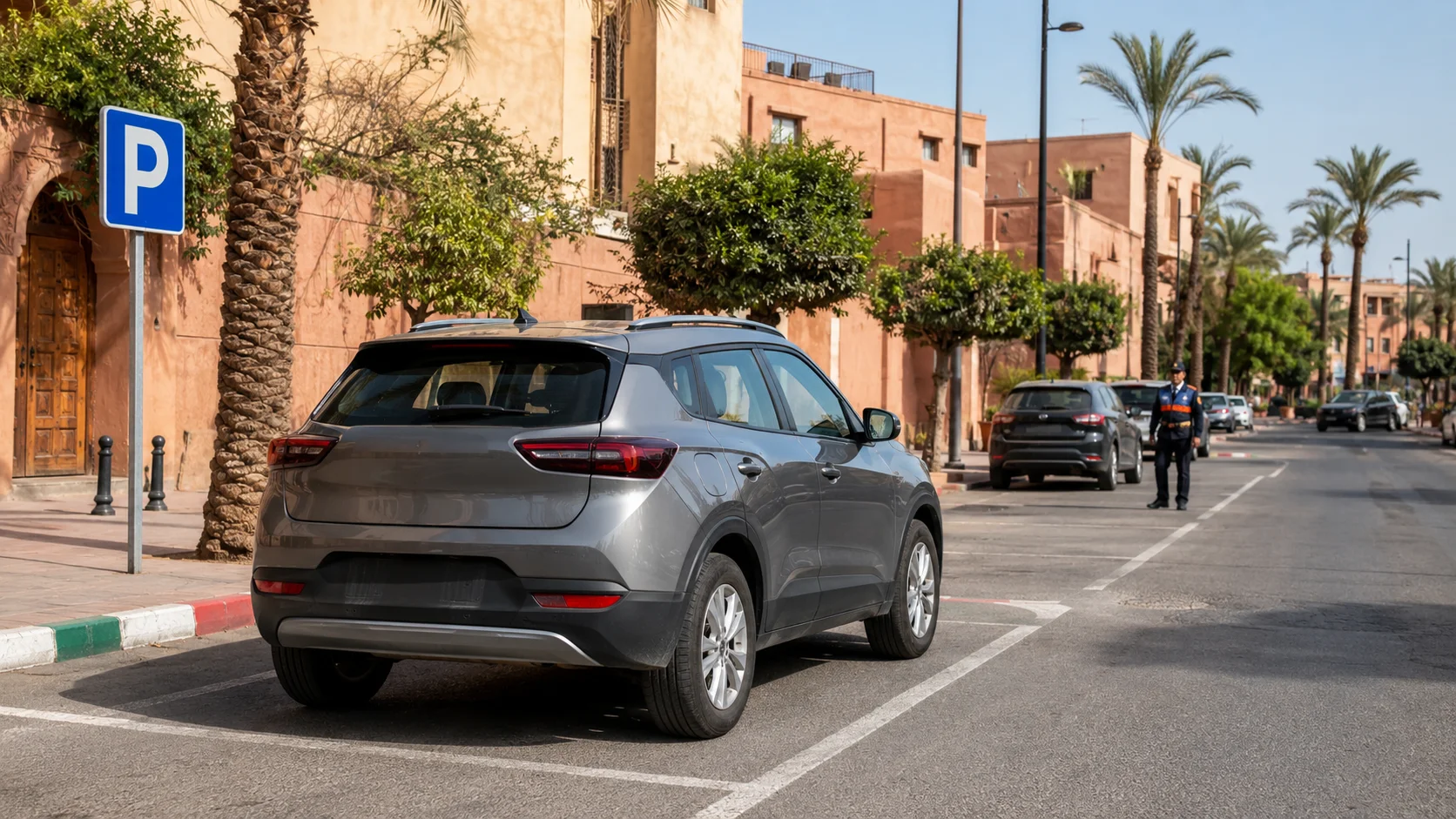
Parking varies much more by city and neighborhood than motorway rules do.
You may encounter:
-
marked roadside parking
-
municipal or metered parking
-
underground car parks
-
private parking facilities
-
hotel parking
-
supervised parking areas
-
restricted streets
-
pedestrian areas where vehicles cannot enter
The safest approach is to rely on the actual parking sign, meter, barrier or instruction at the location.
Do not build your parking strategy around an online claim that a particular curb color always means the same thing across Morocco.
Local arrangements and markings can differ.
Parking in Marrakech
Central Marrakech requires more planning than parking in outer districts.
The historic medina contains narrow streets and large pedestrian or restricted areas where door-to-door vehicle access may not be practical.
If your riad is deep inside the medina, ask for the nearest legal vehicle-access point or parking facility before arrival.
For hotels outside the medina, confirm whether the property has its own parking or uses a nearby facility.
Parking in Fes
Fes presents a similar issue around Fes el Bali.
The historic medina is not a conventional driving environment. Visitors normally need to leave the vehicle outside pedestrian sections and continue on foot.
When accommodation advertises parking, check whether the parking is actually at the property or at a nearby access point.
Parking in Tangier
Modern Tangier generally provides more conventional street access, but areas around the old medina, busy central districts and popular coastal zones can become congested.
For a rental car, a hotel with confirmed parking can be more convenient than repeatedly searching for street parking.
Parking in Casablanca and Rabat
Casablanca and Rabat have wider urban road networks, but central districts can still have controlled or paid parking.
Watch carefully for:
-
parking meters
-
signs restricting stopping
-
loading zones
-
entrance ramps
-
taxi areas
-
reserved spaces
-
temporary restrictions
Never assume that vehicles already parked illegally make a space legal.
What Happens If Your Hotel Is Inside a Medina?
Contact the accommodation before driving into the old city.
Ask:
“What is the nearest point I can legally reach by car, and where should I park?”
That question is more useful than simply asking whether the hotel has “access.”
In Marrakech, Fes and other historic cities, walking the final part of the journey may be normal.
Does Morocco Have Motorway Tolls?
Yes. Large parts of Morocco's motorway network are tolled and operated by the Société Nationale des Autoroutes du Maroc, generally known as ADM.
ADM states that the country's motorway network extends for approximately 1,800 km.
The principal motorway corridors listed by ADM include:
-
A1 Rabat–Safi
-
A2 Rabat–Oujda
-
A3 Casablanca–Agadir
-
A4 Berrechid–Beni Mellal
-
A5 Port Tanger Med–Rabat
-
A7 Tetouan–Fnideq
These corridors make motorway driving particularly useful for long journeys between northern, central and southern Morocco.
How Do You Pay Morocco Motorway Tolls?
ADM currently lists four accepted payment methods at its toll stations:
-
Jawaz electronic toll pass
-
Bank card
-
ADM network card
-
Cash
For a tourist using a rental car, cash or bank card may be the simplest option unless the rental vehicle already carries a usable Jawaz pass.
Confirm with the rental company before using an electronic toll lane.
What Is Jawaz?
Jawaz is ADM's electronic toll-payment system.
Vehicles using designated Jawaz lanes can pass without making a conventional toll payment at the booth. ADM instructs Jawaz users to travel through these lanes at 20 km/h.
If your rental vehicle has a Jawaz device, ask the rental provider how toll charges are handled before starting the journey.
Do not assume the device is active simply because one is visible in the vehicle.
How Much Are Motorway Tolls in Morocco?
Toll prices depend on the route and vehicle class.
For example, the current ADM tariff page lists Casablanca–Rabat at 25 MAD for a Class 1 vehicle.
ADM classifies vehicles according to measurable characteristics including vehicle height, number of axles and length.
Because tariffs can change, travelers planning a future journey should check the current ADM tariff schedule rather than relying on an old blog article or screenshot.
ADM also directs drivers to its traffic platform for current toll information.
Major Motorway Routes Tourists Commonly Use
Casablanca to Rabat
The motorway connection between Casablanca and Rabat is one of Morocco's most important urban corridors.
The official current Class 1 toll listed for the complete Casablanca–Rabat section is 25 MAD.
Casablanca to Marrakech and Agadir
The A3 corridor links Casablanca with Marrakech and continues toward Agadir, making it one of the most useful routes for travelers planning a north-to-south road trip. ADM lists Casablanca–Agadir as one of the principal routes in its motorway network.
Rabat to Tangier
Northern journeys use the motorway corridor toward Kenitra and Tangier.
The route also connects toward Tanger Med, Morocco's major port complex. ADM's current network identifies this corridor as part of the A5 Port Tanger Med–Rabat motorway.
Rabat to Fes and Oujda
The A2 runs east from Rabat toward Fes and Oujda.
For long intercity journeys, this provides a very different driving environment from slower national or regional roads.
Are There Service Areas on Moroccan Motorways?
Yes.
ADM operates a network of motorway service and rest areas. Service areas may provide facilities in addition to parking and rest space, and ADM publishes locations across routes including Casablanca–Agadir, Rabat–Tanger Med and Rabat–Oujda.
For a long road trip, use motorway service areas for planned breaks rather than waiting until you are tired.
Can You Make a U-Turn on a Moroccan Motorway?
No.
ADM explicitly states that making a U-turn on a motorway is prohibited by law because of the danger to the driver and other road users.
If you miss an exit, continue to the next legal exit or interchange and allow your navigation system to recalculate.
Never reverse along the shoulder or attempt to cross the central reservation.
What If You Break Down on the Motorway?
ADM provides motorway assistance and publishes current information about its support and towing services.
Its motorway call center 5050 provides information including toll rates, breakdown tariffs and service-area information and operates around the clock for listed information services.
For a rental vehicle, you should also follow the breakdown procedure provided by the rental company.
Do not independently arrange repairs before checking what your rental agreement requires.
Motorway or National Road: Which Is Better?
It depends on the journey.
Choose the Motorway When:
-
the cities are connected by the motorway network
-
journey time matters
-
you want more predictable intercity driving
-
you prefer service areas and controlled-access roads
-
the toll cost is acceptable
Choose National or Regional Roads When:
-
the motorway does not serve your destination
-
you are traveling to smaller towns
-
the journey itself is part of the trip
-
your route leads into mountain, coastal or rural areas
A road being shorter on a map does not necessarily mean it will be faster.
Traffic through villages, intersections, lower limits and mountain sections can significantly change travel time.
Driving in Moroccan Cities vs Intercity Driving
Driving conditions change substantially between urban and long-distance routes.
Casablanca
Expect dense traffic, multilane roads, frequent junctions and more complex urban navigation.
Marrakech
Traffic around central Marrakech can mix cars, taxis, motorcycles, buses, bicycles and pedestrians. Medina access requires additional planning.
Rabat
The capital has major arterial roads and motorway connections toward Casablanca, Kenitra, Tangier, Fes and other destinations.
Tangier
Tangier provides access toward Rabat and Tanger Med through the northern motorway network, while other destinations such as Chefchaouen involve different road types.
Fes
Driving outside the historic medina is conventional, but access around Fes el Bali requires careful parking and accommodation planning.
Agadir
Agadir connects to Marrakech and Casablanca through the A3 motorway system.
Common Driving Mistakes Tourists Should Avoid
1. Assuming 100 km/h Applies Until the Town Center
Start looking for lower speed signs as soon as the road approaches a built-up area.
2. Following Another Driver Through a Checkpoint
Watch the officer, not the vehicle ahead.
3. Treating Navigation-App Travel Time as Guaranteed
Road conditions, speed restrictions, city traffic and stops can all change actual journey time.
4. Assuming Every Parking Space Is Free
Check the signs, meter or parking facility.
5. Driving Directly Toward a Medina Riad Without Checking Access
Find out the closest legal vehicle-access and parking point first.
6. Entering a Jawaz Lane Without Knowing Whether the Rental Car Has Active Jawaz
Ask the rental company before the journey.
7. Missing a Motorway Exit and Trying to Reverse
Continue to the next safe exit. Motorway U-turns are prohibited.
8. Trusting an Old Toll Table
Check ADM's current tariff information because route prices are subject to revision.
A Practical Morocco Road-Trip Routine
Before leaving each morning:
1. Check the route.
Identify whether the journey uses an autoroute, national road, mountain road or city streets.
2. Check fuel.
Do not begin a long rural journey assuming the next station will be close.
3. Check parking at the destination.
This is especially important for medinas and historic centers.
4. Keep required documents accessible.
5. Follow posted speed limits.
6. Allow extra time for town crossings and checkpoints.
7. Take regular breaks on long journeys.
ADM provides real-time motorway traffic information through its ADM Trafic platform across the motorway network.
Is Driving in Morocco Difficult for Tourists?
For most confident drivers, Morocco is manageable once the differences between motorway, city and rural driving are understood.
Motorway travel is generally the simplest environment. Urban centers require greater attention because traffic density, pedestrians, motorcycles, junctions and parking can increase workload.
Mountain and rural routes require a different type of caution: lower practical speeds, curves, settlements and changing road conditions can make distance a poor predictor of travel time.
The most useful principle is:
Drive according to the road in front of you, not according to the maximum speed shown by your navigation app.
Frequently Asked Questions
What is the speed limit in Morocco?
For ordinary passenger cars, the commonly applicable maximum is 120 km/h on motorways, 100 km/h outside built-up areas and 60 km/h in built-up areas unless signs specify another limit.
Are there police checkpoints in Morocco?
Yes. Road checkpoints and traffic controls are common on Moroccan roads, including around town approaches and major routes. Slow down and follow the officer's instructions.
Does Morocco have speed cameras?
Yes. Fixed speed cameras and mobile speed enforcement are used in Morocco.
Do tourists have to pay motorway tolls in Morocco?
Drivers using tolled sections of the ADM motorway network must pay the applicable toll unless it is handled through an electronic payment arrangement such as Jawaz.
Can I pay Moroccan motorway tolls by card?
ADM currently lists bank cards as an accepted toll-payment method, alongside cash, Jawaz and network cards.
How much is the motorway from Casablanca to Rabat?
ADM's current tariff table lists the full Casablanca–Rabat journey at 25 MAD for a Class 1 vehicle. Check ADM before travel in case tariffs are revised.
Is parking free in Morocco?
It depends on the location. Moroccan cities contain a mixture of paid street parking, private facilities, hotel parking and restricted areas. Always follow the signs and payment instructions at the actual location.
Can I drive into the Marrakech or Fes medina?
Do not assume your accommodation is directly accessible by car. Historic medina areas contain pedestrian and restricted sections. Confirm the nearest legal vehicle-access point and parking location with your accommodation before arrival.
What should I do if I miss an exit on a Moroccan motorway?
Continue to the next legal exit and reroute. Do not reverse or make a U-turn. ADM states that U-turns on motorways are prohibited.
What number should I use for information on the Moroccan motorway?
ADM operates its 5050 motorway call center, providing information on matters including tolls, breakdown services and service areas.
Final Driving Advice for Morocco in 2026
The main rules for a Morocco road trip are easier to remember than they first appear.
Use 120 km/h, 100 km/h and 60 km/h as general reference limits, but let the posted sign control your actual speed.
Expect road checks without treating them as unusual. Plan parking before entering historic centers. Carry suitable payment options for motorways, and use the official ADM tariff and traffic information when planning long motorway journeys.
Most importantly, allow time.
A Moroccan road trip is easier when you are not rushing through a town, searching for parking at the last minute or trying to make up time between cities.