






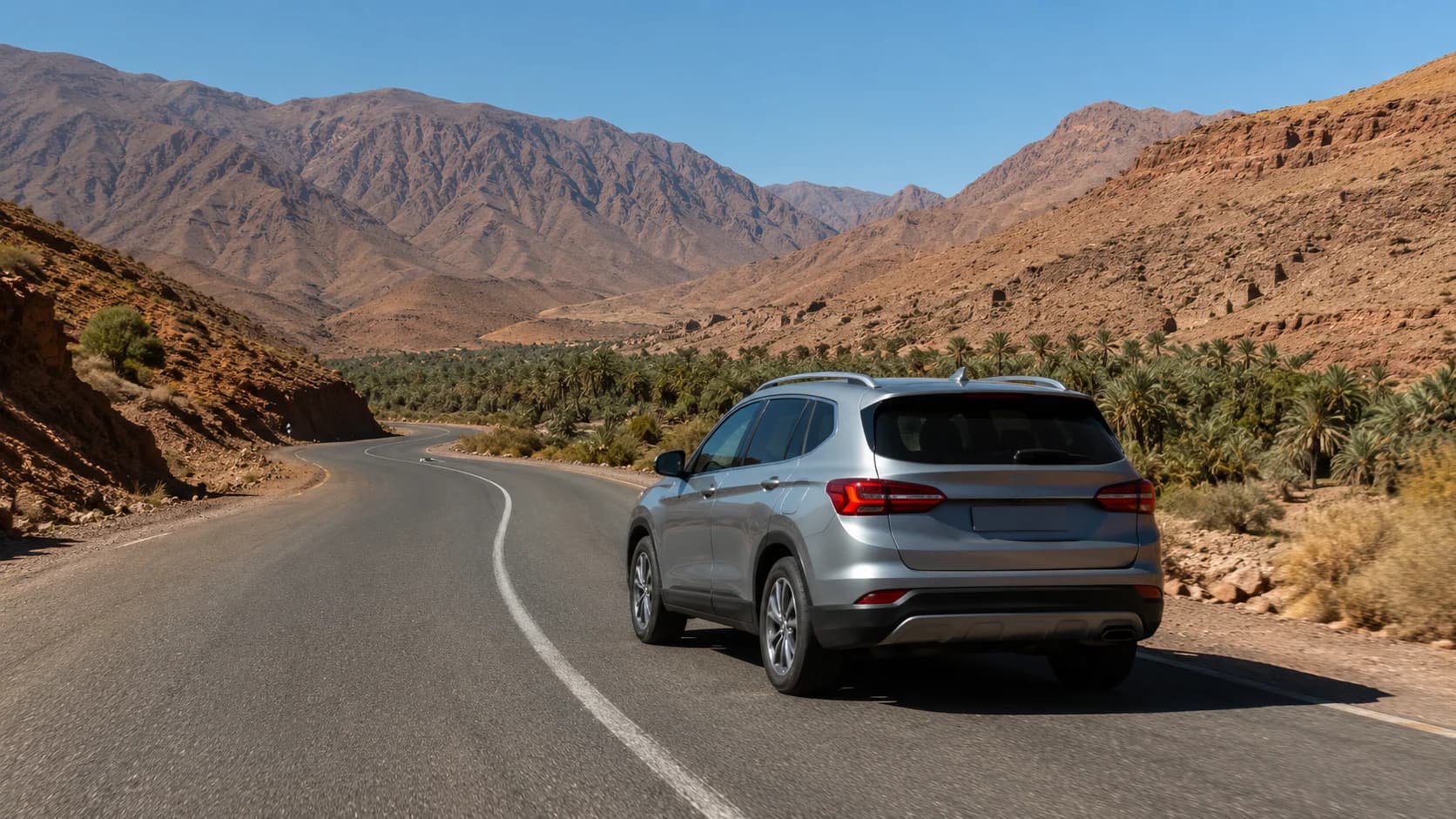
Driving from Marrakech to Merzouga by car is one of Morocco's most rewarding long-distance road trips. The journey leaves Marrakech, crosses the High Atlas Mountains, passes the Tizi n'Tichka area and Ouarzazate, follows the landscapes of the Dadès and Tinghir region, and eventually reaches Merzouga beside the Erg Chebbi dunes. The distance is roughly 560 km one way, but this is not a route where distance tells the whole story. Mountain roads, scenic stops and long southeastern stretches mean most travelers should treat the drive as a multi-day Sahara road trip rather than simply a transfer between two points.
Can You Drive From Marrakech to Merzouga?
Yes. You can drive from Marrakech to Merzouga in a normal roadworthy rental car using paved roads for the main journey. The trip is approximately 560 km one way and usually requires around 9 to 10 hours of actual driving, depending on the exact route, traffic, weather and stops.
The practical route heads from Marrakech toward Ouarzazate across the High Atlas, then east through the Dadès and Tinghir corridor before continuing toward Erfoud and Merzouga.
Although driving it in one very long day is possible, splitting the journey over at least two days is considerably more practical. A three- or four-day itinerary gives you time for places such as Aït Ben Haddou, Ouarzazate, the Dadès Valley, Todra Gorge and Erg Chebbi instead of spending almost the entire trip behind the wheel.
Marrakech to Merzouga at a Glance
| Trip detail | What to expect |
|---|---|
| One-way distance | About 560 km |
| Direct driving time | Roughly 9–10 hours |
| Recommended trip length | 2–4 days one way or with sightseeing |
| Main first road | N9 toward Ouarzazate |
| Major mountain crossing | High Atlas / Tizi n'Tichka area |
| Main southeastern corridor | Ouarzazate, Dadès region, Tinghir, Tinejdad |
| Final desert gateway | Erfoud / Merzouga |
| Sahara destination | Erg Chebbi |
| Motorway | No motorway for the main Atlas-to-Merzouga route |
| 4x4 required? | Not for the normal paved road to Merzouga |
| Best vehicle | Reliable compact, sedan or SUV depending on passengers and luggage |
| Major fuel opportunities | Marrakech, Ouarzazate, Tinghir, Tinejdad/Erfoud area |
| Best approach | Start early and avoid unnecessary night driving |
Morocco's National Tourist Office presents Marrakech, Ouarzazate/Tinghir and the Merzouga region as successive stages of a southern Morocco desert itinerary, confirming how naturally these places fit into the same overland journey.
Table of Contents
- How far Marrakech is from Merzouga
- The best road from Marrakech to Merzouga
- Driving across the High Atlas
- Aït Ben Haddou and Ouarzazate
- Dadès Valley and Tinghir
- Todra Gorge
- The final drive toward Erfoud and Merzouga
- Whether you need an SUV or 4x4
- Fuel and road-trip planning
- When to travel
- A practical two-, three- and four-day itinerary
- Self-drive versus a private driver
- Frequently asked questions
How Far Is Merzouga From Marrakech?
Merzouga is approximately 560 km from Marrakech by road using the usual route across the High Atlas and southeastern Morocco.
The drive normally takes around 9 to 10 hours before meaningful sightseeing stops. Morocco's National Tourist Office separates the journey into a Marrakech-to-Ouarzazate/Tinghir stage and a further desert stage toward the Merzouga region, which reflects how most visitors actually experience the route rather than completing it as one continuous drive.
This is why 560 km in southern Morocco should not be planned like 560 km of motorway driving.
The route includes:
-
urban traffic leaving Marrakech
-
mountain climbs and descents
-
bends through the High Atlas
-
slower sections through towns
-
scenic viewpoints
-
possible road works
-
fuel and meal stops
-
attractions that are worth leaving the main road to visit
A sensible road-trip schedule should therefore be based on time and terrain, not distance alone.
What Is the Best Route From Marrakech to Merzouga?
The standard road-trip corridor is:
Marrakech → High Atlas → Tizi n'Tichka → Ouarzazate → Skoura → Kalaat M'Gouna → Boumalne Dadès → Tinghir → Tinejdad → Erfoud area → Merzouga
From Marrakech, the journey initially follows the N9 toward Ouarzazate.
After the High Atlas crossing and Ouarzazate area, the drive continues east through the N10 corridor toward the Dadès and Tinghir region. The N10 is one of the principal roads connecting Ouarzazate with southeastern Morocco and passes through important locations including Kalaat M'Gouna, Boumalne Dadès and Tinghir.
Toward the final portion of the trip, routes through the Tinejdad and Erfoud area connect onward toward Merzouga. Exact navigation around Erfoud can vary according to your mapping application, road works and your chosen stops, so use current navigation rather than relying on a fixed turn-by-turn itinerary written months earlier.
Core Geographic Relationship
Marrakech
↓
High Atlas Mountains
↓
Tizi n'Tichka
↓
Ouarzazate
↓
Skoura
↓
Kalaat M'Gouna
↓
Dadès Valley / Boumalne Dadès
↓
Tinghir / Todra Gorge
↓
Tinejdad
↓
Erfoud
↓
Merzouga / Erg Chebbi
Understanding these entities is more useful than memorizing every junction before departure.
Stage 1: Marrakech to the High Atlas
Leaving Marrakech, the landscape changes quickly as the road approaches the High Atlas.
The N9 begins climbing through increasingly mountainous terrain on the way toward Ouarzazate. This part of the drive is visually spectacular but requires more concentration than Morocco's major autoroutes.
Expect:
-
repeated bends
-
elevation changes
-
slower vehicles
-
occasional overtaking
-
mountain viewpoints
-
variable weather by altitude
Do not build your schedule around an optimistic average speed.
A road that appears short on the map can take considerably longer when you are moving through mountain terrain.
Should You Drive the Atlas Section at Night?
For most first-time visitors, daylight is preferable.
Daylight makes it easier to:
-
read the road ahead
-
identify bends and junctions
-
react to slower vehicles
-
understand changing road conditions
-
enjoy the mountain scenery
If Merzouga is your final goal, leaving Marrakech early is generally much more useful than attempting to save time with late-night driving.
Stage 2: Tizi n'Tichka to Aït Ben Haddou
The Tizi n'Tichka area is one of the best-known High Atlas crossings associated with the Marrakech-to-Ouarzazate journey. Morocco's National Tourist Office lists Tizi n'Tichka among the notable attractions of the Ouarzazate/Tinghir region.
After crossing the mountains, many road trippers make time for Aït Ben Haddou.
The fortified ksar is one of the most important cultural stops accessible along the broader Marrakech-to-Merzouga road trip.
Aït Ben Haddou is a UNESCO World Heritage Site, recognized for its group of earthen buildings surrounded by defensive walls and its representation of traditional pre-Saharan architecture.
If you are already crossing southern Morocco by car, it makes much more sense to include Aït Ben Haddou as a planned stop than attempt to cover Marrakech to Merzouga as quickly as possible.
Stage 3: Ouarzazate
Ouarzazate is the first major city on the southern side of the High Atlas and one of the most practical places to:
-
refuel
-
eat
-
rest
-
buy water
-
check your route
-
stay overnight
The Moroccan National Tourist Office describes the broader Ouarzazate, Zagora and Tinghir area as a landscape of desert environments, valleys and routes connecting the Drâa, Ziz and Dadès regions.
For travelers starting late in Marrakech, Ouarzazate can be a sensible first overnight stop.
For travelers starting early, continuing farther toward Skoura or the Dadès Valley creates a more balanced second day.
Stage 4: Ouarzazate to Skoura and the Dadès Valley
East of Ouarzazate, the road moves into one of the most visually distinctive parts of the trip.
The journey passes through or near:
-
Skoura
-
Kalaat M'Gouna
-
Boumalne Dadès
-
the Dadès Valley
This corridor is often associated with the Road of the Kasbahs, with palm groves, earthen architecture and changing mountain landscapes.
Morocco's tourism office specifically highlights the Dadès Valley as one of the main attractions of the Ouarzazate and Tinghir region.
Should You Detour Into Dadès Gorge?
If you have enough time, yes.
The gorge road is not necessary to reach Merzouga, so it should be treated as a sightseeing detour rather than part of the fastest route.
This distinction matters when planning your itinerary.
If you have only two days to reach the desert, choose stops carefully.
If you have three or four days, the Dadès area deserves more time.
Stage 5: Tinghir and Todra Gorge
Tinghir is another important geographic and practical point on the journey.
The Todra Gorge is reached from the Tinghir area and is one of the most popular natural stops on the southeastern route.
The Moroccan National Tourist Office specifically connects Tinghir with the Todra Gorges and the surrounding palm landscapes.
A visit adds time to your journey, but it is much easier to incorporate into a multi-day road trip than to return separately from Marrakech.
Tinghir is also a good place to:
-
refuel
-
buy food and water
-
take a driving break
-
review your arrival time in Merzouga
From here, the landscape becomes increasingly arid as you continue toward the Tafilalet and desert gateway region.
Stage 6: Tinghir to Erfoud
Continue east through southeastern Morocco toward Tinejdad and the Erfoud area.
This part of the trip has fewer major tourist cities than the Marrakech-to-Tinghir section, so fuel planning becomes more important.
You do not need to panic about fuel availability, but there is little reason to pass a convenient station with an almost-empty tank.
A practical rule on long Moroccan road trips is simple:
Do not wait until the warning light appears before looking for fuel.
Keep enough range for unexpected diversions, a closed station or a change of plan.
Stage 7: Erfoud to Merzouga and Erg Chebbi
Erfoud is one of the principal gateways to the Tafilalet and Merzouga region.
From here, the desert environment becomes increasingly obvious as you approach Merzouga and Erg Chebbi.
The Moroccan National Tourist Office describes Merzouga as one of Morocco's gateways to the Sahara and identifies Erg Chebbi as a landscape of dunes, palm groves, tracks and desert activities.
That distinction is useful:
Merzouga is the settlement and desert tourism base.
Erg Chebbi is the major dune system beside it.
Travelers sometimes use "Merzouga desert" and "Erg Chebbi" interchangeably, but they are not exactly the same geographic entity.
Do You Need a 4x4 From Marrakech to Merzouga?
No. A 4x4 is not required to drive the normal paved route from Marrakech to Merzouga.
A well-maintained compact car, sedan or SUV can handle the main paved journey under normal road and weather conditions.
Your vehicle choice should depend more on:
-
passenger count
-
luggage
-
driving comfort
-
rental length
-
planned detours
-
whether you intend to leave paved roads
When Does an SUV Make Sense?
An SUV can be useful when:
-
you have several passengers
-
you carry substantial luggage
-
you prefer a higher driving position
-
the trip includes many days of driving
-
you want additional comfort on rougher secondary roads
Travelers planning the journey can compare SUV rental in Marrakech before departure.
When Might You Need a 4x4?
A 4x4 becomes relevant if your accommodation or activity requires leaving established paved roads and following desert tracks.
Do not drive an ordinary rental car onto sand simply because your desert camp appears close on a map.
Many desert camps arrange their own meeting point, transfer or 4x4 transport for the final off-road section.
Confirm this with your accommodation before arriving.
Renting a Car in Marrakech for the Merzouga Road Trip
A long Sahara road trip places different demands on a rental car than driving around Marrakech for a weekend.
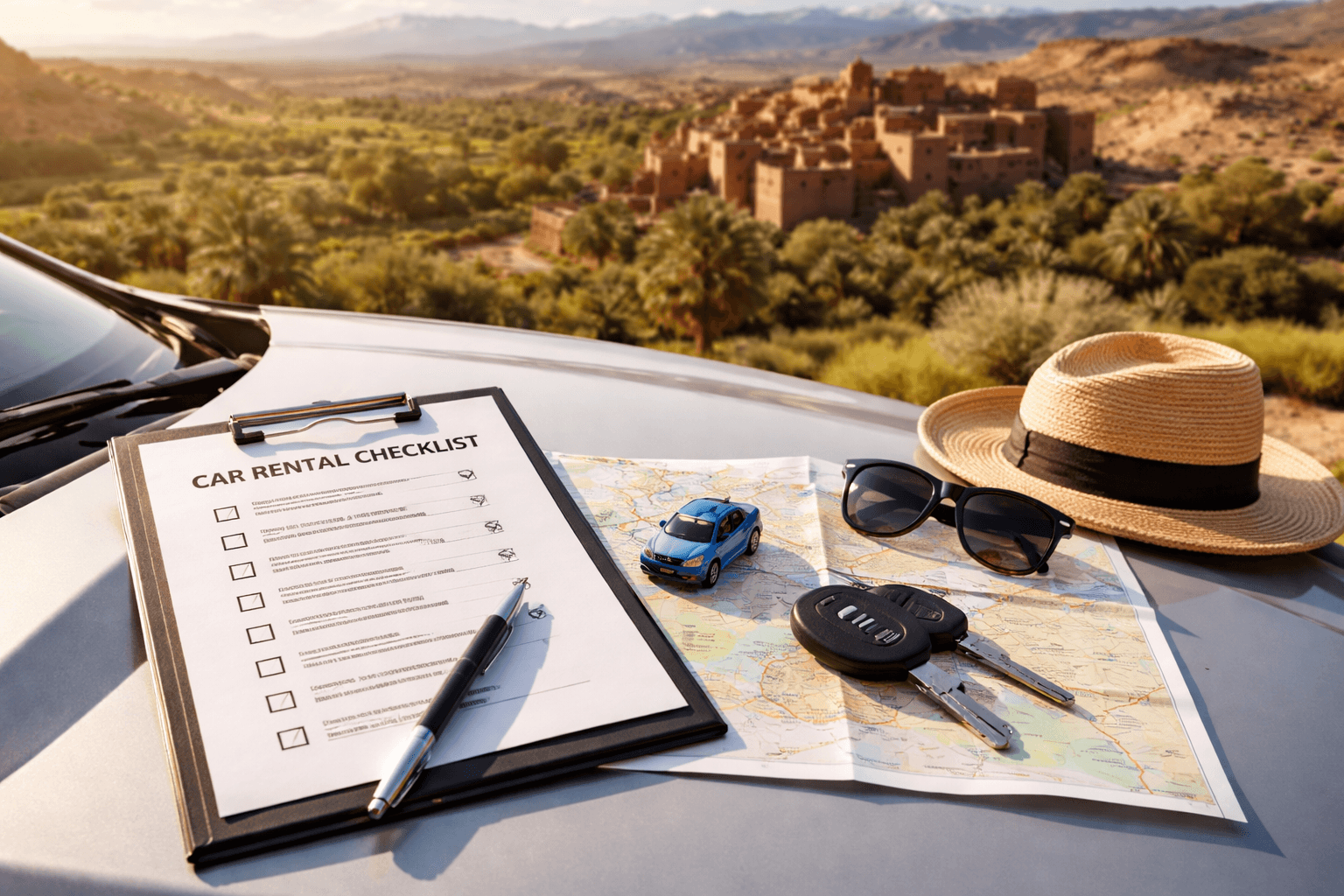
Before leaving, check:
-
tyre condition
-
spare wheel or puncture solution
-
fuel policy
-
insurance terms
-
kilometre allowance
-
roadside-assistance contact
-
air conditioning
-
lights
-
windscreen condition
-
luggage capacity
You can compare car rental in Marrakech before choosing a vehicle for the route.
For travelers who prefer to avoid holding a large security deposit, MarHire also lists no-deposit car rental options in Marrakech.
For a journey of this length, do not choose purely by the cheapest daily price. A vehicle that comfortably fits your passengers and luggage may make hundreds of kilometres of driving considerably easier.
Fuel Planning Between Marrakech and Merzouga
The route passes through several towns and cities where fuel is available.
Useful refuelling points include:
-
Marrakech
-
Ouarzazate
-
Boumalne Dadès area
-
Tinghir
-
Tinejdad area
-
Erfoud
You do not necessarily need to stop at every location.
Instead:
-
Start with sufficient fuel.
-
Refill before entering long stretches with fewer services.
-
Avoid running close to empty.
-
Keep water in the vehicle.
-
Do not assume every small roadside station shown in an old map listing will be operating.
This is particularly sensible in hotter months.
Is There a Toll From Marrakech to Merzouga?
The main Marrakech-to-Merzouga route through the High Atlas is based on national and regional roads rather than Morocco's tolled autoroute network.
You should therefore not expect the type of repeated motorway toll booths encountered on routes such as Casablanca to Marrakech or Rabat to Tangier.
However, always follow your live navigation if you add other cities before or after the desert journey.
Best Time of Year to Drive From Marrakech to Merzouga
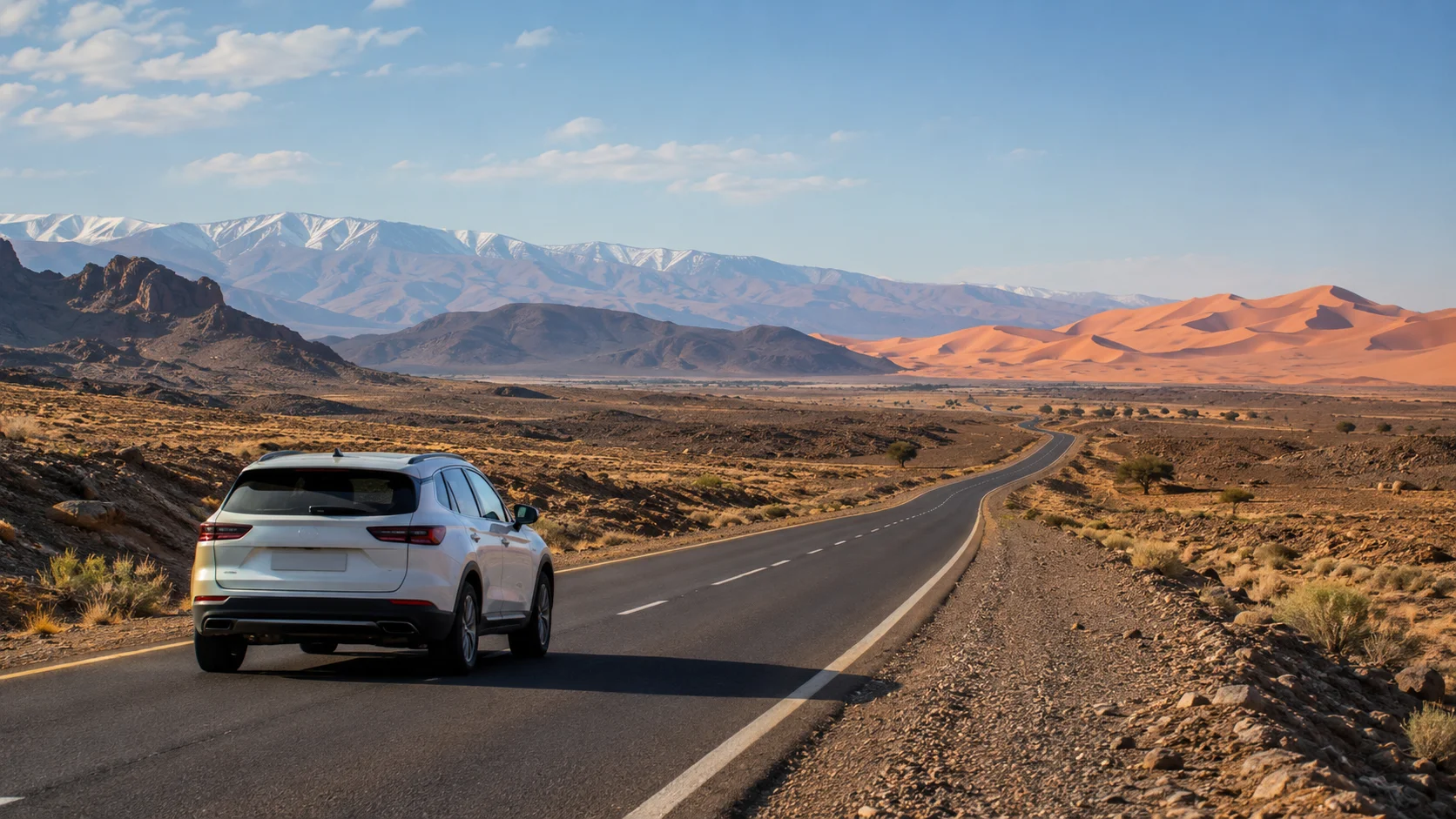
The road is used throughout the year, but conditions differ dramatically between the High Atlas and Sahara.
Spring
Spring can offer comfortable road-trip conditions, with moderate temperatures compared with the hottest part of summer.
Summer
Merzouga and the southeastern desert can become extremely hot.
Summer travelers should:
-
carry plenty of water
-
ensure the air conditioning works
-
avoid unnecessary exposure around midday
-
avoid leaving electronics or heat-sensitive items in the car
-
plan activities according to local conditions
Autumn
Autumn is another popular period for combining mountain driving with desert travel.
Winter
The desert can be pleasant during the day but cold after sunset.
The High Atlas presents a separate issue: winter weather at altitude can affect road conditions.
Before departure, check the latest forecast and current road situation rather than assuming Marrakech weather reflects conditions at the mountain pass.
Is It Better to Drive Marrakech to Merzouga in One Day?
Usually, no.
It may be physically possible, but it removes much of the reason to travel this route by car.
A direct day can mean:
Marrakech → approximately 9–10 hours of driving → Merzouga
A road-trip itinerary can become:
Marrakech → Atlas → Aït Ben Haddou → Ouarzazate → Dadès → Todra → Merzouga
The second version turns the journey itself into part of the trip.
It also reduces the pressure to continue driving after dark simply to reach a desert camp reservation.
Two-Day Marrakech to Merzouga Itinerary
If your time is limited:
Day 1: Marrakech to Dadès Area
Marrakech → Tizi n'Tichka → Aït Ben Haddou → Ouarzazate → Dadès
Leave Marrakech early.
Choose only a few substantial stops rather than stopping at every viewpoint.
Stay around Boumalne Dadès or another convenient point in the valley.
Day 2: Dadès to Merzouga
Dadès → Tinghir → Todra Gorge → Tinejdad → Erfoud → Merzouga
Visit Todra early, continue toward Erfoud and aim to reach Merzouga with enough daylight remaining to locate your hotel or camp meeting point.
This is a busy itinerary but much better than trying to complete everything in one day.
Three-Day Marrakech to Merzouga Itinerary
For most travelers, three days gives a better balance.
Day 1
Marrakech → High Atlas → Aït Ben Haddou → Ouarzazate
Explore Aït Ben Haddou and spend the night around Ouarzazate or continue to Skoura.
Day 2
Ouarzazate/Skoura → Dadès → Tinghir → Todra → Merzouga
Drive through the valley corridor, visit Todra and arrive around Merzouga later in the day.
Day 3
Use the morning for Erg Chebbi, desert activities or a relaxed departure.
If you must return all the way to Marrakech on day three, understand that the return is still a very long drive.
A three-day round trip is therefore possible but intensive.
Four-Day Sahara Road Trip
Four days provides considerably more flexibility.
One possible plan is:
Day 1
Marrakech → Aït Ben Haddou → Ouarzazate
Day 2
Ouarzazate → Skoura → Dadès → Tinghir
Day 3
Todra Gorge → Erfoud → Merzouga → Erg Chebbi
Day 4
Merzouga → Marrakech
Even this plan includes a long final driving day.
If your schedule allows five days, you can reduce driving pressure further or add another overnight stop on the return.
Marrakech to Merzouga: Rental Car or Private Driver?
Both options work, but they suit different travelers.
| Factor | Rental car | Private driver |
|---|---|---|
| Freedom to stop | Excellent | Excellent with agreed itinerary |
| Navigation | You handle it | Driver handles it |
| Mountain driving | You drive | Driver drives |
| Parking | You handle it | Driver handles it |
| Flexible departure times | High | High |
| Driving fatigue | High on long days | Low |
| Road-trip independence | Maximum | Moderate to high |
| Best for | Independent travelers | Travelers prioritizing comfort |
Self-driving is best when the road trip itself is part of your holiday.
A driver makes more sense if you want to see the route without concentrating on several hundred kilometres of unfamiliar roads.
Travelers who prefer not to self-drive can compare a private driver in Marrakech or intercity travel with a driver from Marrakech.
What Travelers Should Know Before Driving to Merzouga
A few practical decisions make a bigger difference than choosing the most expensive vehicle.
Start Early
An early start gives you more daylight for the Atlas crossing and allows flexibility if sightseeing stops take longer than expected.
Download Offline Navigation
Mobile coverage is generally useful, but an offline map provides backup if reception becomes weak.
Do Not Chase a Sunset Reservation
If you have booked a sunset activity in Merzouga, leave substantial time.
It is better to miss a camel ride than turn a mountain and desert drive into a race against the clock.
Confirm Your Desert Camp Meeting Point
A camp marked near Erg Chebbi may not mean you should drive directly to its coordinates.
Ask:
-
where should I park?
-
is the approach paved?
-
is a 4x4 transfer included?
-
what time should I arrive?
-
who do I contact in Merzouga?
Keep Water in the Car
This is basic but important, especially on long southeastern sections and during warmer months.
Avoid Unnecessary Night Driving
Arrival after dark makes unfamiliar junctions, rural roads and camp meeting points more difficult than they need to be.
Why the Marrakech to Merzouga Road Trip Is Worth Doing
The strongest reason to drive is not simply reaching the Sahara.
It is the sequence of landscapes between Marrakech and Merzouga.
In one road trip, you move through:
Marrakech → High Atlas → earthen kasbah landscapes → oasis valleys → rocky southeastern plateaus → Sahara dunes
The Moroccan National Tourist Office treats Ouarzazate, Tinghir and Merzouga as major components of southern Morocco's desert experience, with Dadès, Todra, Tafilalet and Erg Chebbi forming part of the broader geographic story.
That is why driving can be preferable to treating Merzouga as a destination to reach as fast as possible.
Frequently Asked Questions
How long does it take to drive from Marrakech to Merzouga?
Allow approximately 9 to 10 hours of actual driving for the roughly 560 km journey. Sightseeing, meals, fuel stops, traffic and mountain-road conditions can extend the total journey significantly.
Can you drive from Marrakech to Merzouga in one day?
Yes, but it creates a very long driving day and leaves little time for the attractions between Marrakech and Merzouga. Two days is more practical, while three or four days creates a better Sahara road-trip experience.
What road do you take from Marrakech to Merzouga?
The usual route leaves Marrakech on the N9 toward Ouarzazate, then continues through the southeastern corridor toward the Dadès Valley, Tinghir, Tinejdad and Erfoud before reaching Merzouga. Navigation around the final section can vary, so follow current road information.
Is the Marrakech to Merzouga road paved?
The main route to Merzouga uses paved roads. Leaving the paved network for remote desert camps, dunes or tracks is a different matter and may require dedicated 4x4 transport.
Do I need an SUV to drive from Marrakech to Merzouga?
No. An SUV is not essential for the main paved route. A standard roadworthy rental car can complete the journey in normal conditions. An SUV may provide extra space and comfort for families, luggage or longer itineraries.
Do I need a 4x4 in Merzouga?
Not to reach Merzouga village on the normal road. A 4x4 may be required for specific off-road tracks or desert camps. Ask your accommodation where to leave your rental vehicle before driving onto unpaved terrain.
Is Marrakech to Merzouga a good road trip for tourists?
Yes, provided you are comfortable with long-distance driving and mountain roads. The route connects several major southern Morocco attractions and offers considerably more flexibility than point-to-point transport.
Where should I stop between Marrakech and Merzouga?
The most useful stops include the High Atlas, Aït Ben Haddou, Ouarzazate, Skoura, the Dadès region, Tinghir, Todra Gorge and Erfoud. You do not need to visit every location on one trip.
Where should I sleep between Marrakech and Merzouga?
For a two-day drive, the Dadès/Boumalne area creates a practical overnight break. For a slower itinerary, Ouarzazate or Skoura can form the first overnight stop, followed by the desert around Merzouga.
Is Merzouga the Sahara Desert?
Merzouga is a village and tourism base beside Erg Chebbi, one of Morocco's major Saharan dune areas. The Moroccan National Tourist Office describes Merzouga as one of the country's gateways to the Sahara.
Plan Your Marrakech to Merzouga Road Trip
Driving from Marrakech to Merzouga gives you the freedom to experience the High Atlas, Ouarzazate, the Dadès region, Todra Gorge and Erg Chebbi as one connected journey rather than separate excursions.
Before departure, choose a car based on your passengers, luggage and itinerary, check the kilometre and insurance terms, and leave enough time to travel during daylight.
Explore car rental in Marrakech, compare SUV rental in Marrakech, or choose a private driver in Marrakech if you would rather experience the Sahara route without handling the driving yourself.