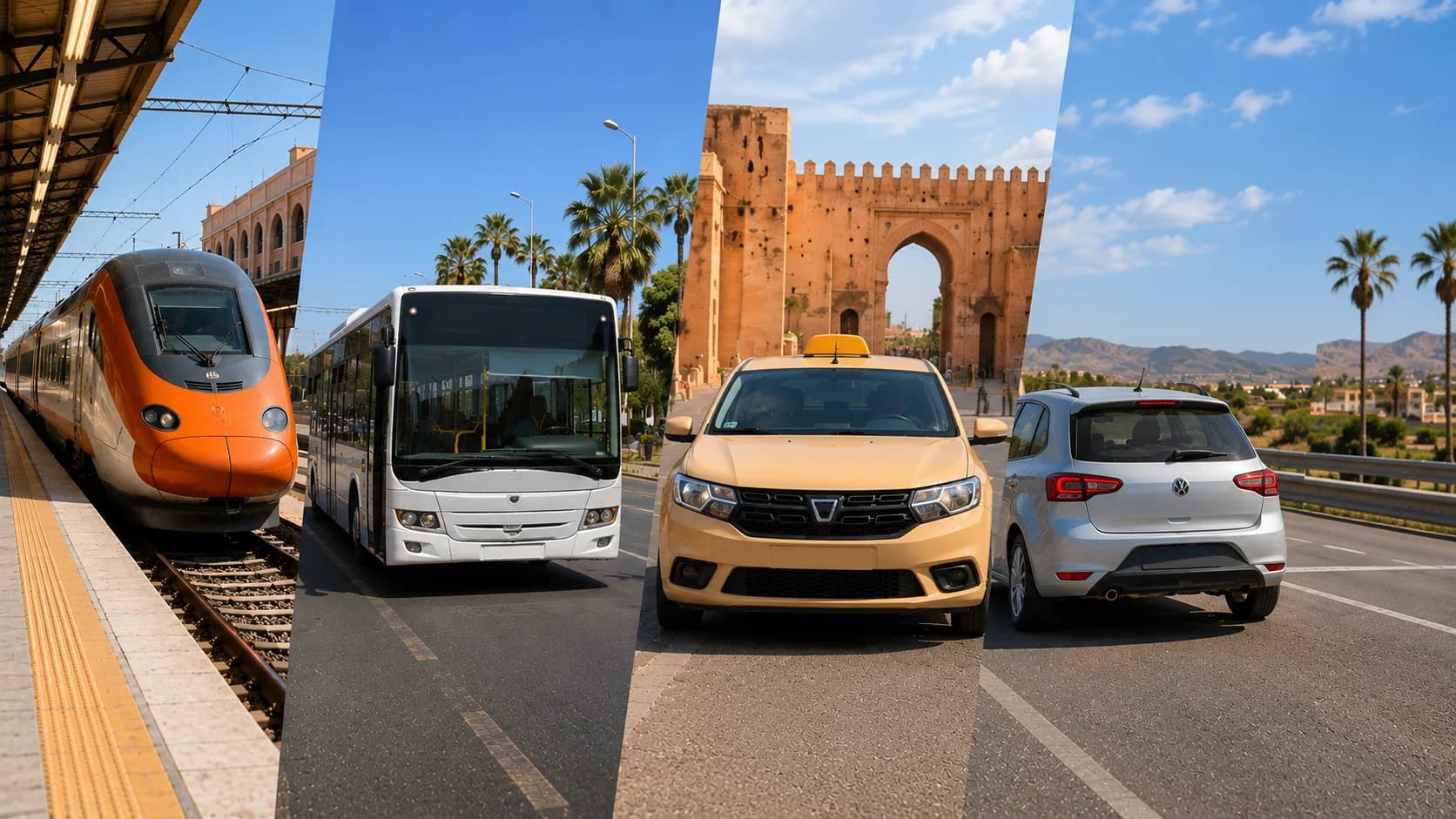





Driving in Morocco for the first time can feel unfamiliar during the first few kilometres, especially if you arrive in a busy city such as Marrakech, Casablanca, Tangier or Fes. However, once you understand the basic road rules, speed limits, motorway system, parking habits and local driving style, having your own car can be one of the most practical ways to explore the country.
Morocco drives on the right, major cities are connected by an extensive road and motorway network, and rental cars give tourists access to destinations that are difficult to combine efficiently by public transport. This 2026 guide explains what first-time visitors need to know before getting behind the wheel, from licences and insurance to mountain roads, police checks, tolls, fuel and driving at night.
Table of Contents
- Is Driving in Morocco Easy for Tourists?
- What driving in Morocco is really like
- Driving licence requirements for tourists
- Documents to carry
- Moroccan speed limits
- Motorways and toll roads
- Police checks and speed enforcement
- Driving in Moroccan cities
- Roundabouts and intersections
- Rural and mountain roads
- Driving at night
- Fuel stations
- Parking
- Choosing the right rental car
- What to check before accepting a rental vehicle
- Accidents and breakdowns
- Recommended first-time road trips
- Frequently asked questions
Is Driving in Morocco Easy for Tourists?
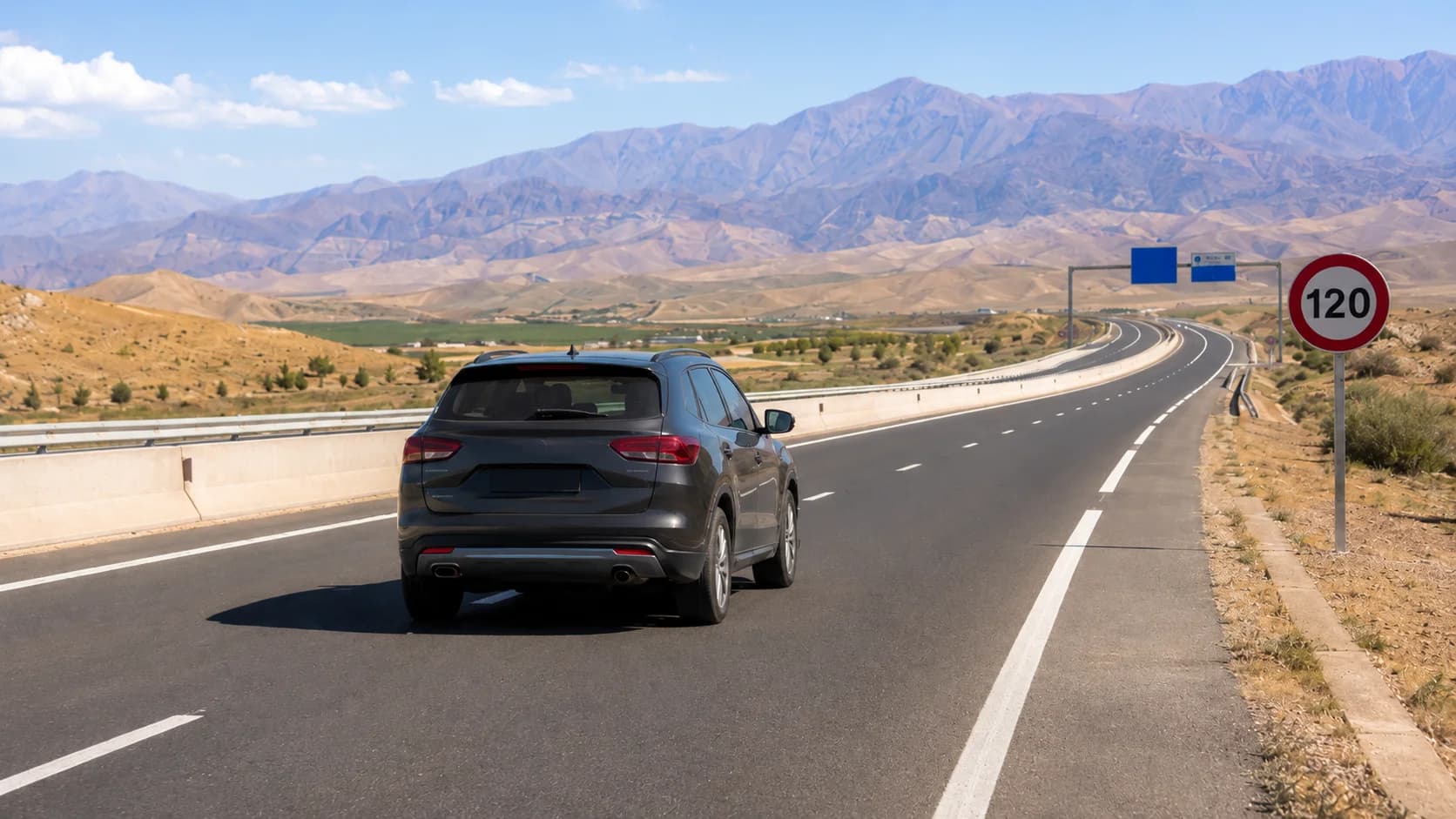
Yes. Many tourists drive successfully in Morocco, particularly on motorways and the main national roads between cities. Morocco drives on the right, road signs commonly use Arabic and French, and the legal motorway speed limit is generally 120 km/h. The biggest adjustment for first-time visitors is usually city traffic, pedestrians, scooters, roundabouts and slower traffic on rural roads.
For a first trip, allow extra travel time, follow posted speed limits rather than the speed of surrounding traffic, avoid unnecessary night driving on unfamiliar rural roads and choose a rental vehicle that fits your actual route.
Driving in Morocco at a Glance
| Question | Quick answer |
|---|---|
| Which side of the road? | Right |
| Motorway speed limit | Up to 120 km/h where posted |
| Typical main-road limit | Often up to 100 km/h |
| Urban limit | Commonly up to 60 km/h, but follow local signs |
| Motorways tolled? | Yes, on many major routes |
| Toll payment | Cash, bank card or Jawaz depending on lane |
| Road signs | Commonly Arabic and French |
| Manual or automatic cars? | Manual is common; automatics are available |
| Safe for tourists? | Generally manageable with defensive driving |
| Driving at night? | Best minimized on unfamiliar rural and mountain roads |
| Fuel availability | Good on major routes and near cities |
| Best vehicle | Depends on route, luggage and passengers |
Morocco's National Tourist Office confirms that vehicles drive on the right and that road signage is commonly presented in Arabic and French.
What Is Driving in Morocco Really Like?
Driving conditions vary significantly depending on where you are.
A motorway journey from Casablanca to Rabat feels very different from driving through Marrakech, crossing the High Atlas Mountains or approaching a small village on a secondary road.
Most first-time visitors find Morocco easier to drive once they divide the road network into four categories.
Motorways
Morocco's motorways are generally the simplest roads for international visitors.
The Autoroutes du Maroc network connects many important destinations, including routes serving Casablanca, Rabat, Tangier, Marrakech, Agadir, Fes and Oujda. ADM currently lists routes including the A1, A2, A3, A4, A5 and A7 as parts of the motorway system.
These roads are controlled-access routes and are often the best option for long intercity journeys.
National Roads
National roads connect cities, towns and areas not directly served by motorways.
They can be excellent roads, but conditions and traffic patterns vary. You may encounter:
-
tractors
-
motorcycles
-
pedestrians
-
bicycles
-
animals
-
slow trucks
-
local taxis
-
vehicles entering from side roads
A 100 km distance on a national road should therefore not automatically be treated as a one-hour drive.
City Roads
Casablanca, Marrakech, Tangier, Agadir, Rabat and Fes all have their own traffic patterns.
Expect more:
-
scooters
-
pedestrians
-
taxis
-
lane changes
-
busy roundabouts
-
informal stopping
-
delivery vehicles
The best approach is defensive driving rather than trying to copy the most aggressive driver around you.
Mountain and Rural Roads
Mountain roads require the most planning.
Routes through the High Atlas, Middle Atlas and Rif Mountains may involve:
-
steep gradients
-
tight bends
-
limited overtaking opportunities
-
fog
-
rain
-
snow in some high-altitude areas
-
rockfall or road works
-
animals on the road
Poor weather can make secondary and mountain routes particularly hazardous, according to current UK travel guidance for Morocco.
What Driving Licence Do Tourists Need in Morocco?
Do not assume that one driving-licence rule applies to every nationality.
Requirements can depend on:
-
the country that issued your licence
-
the language or script used on the licence
-
length of stay
-
the rental company
-
insurance conditions
-
whether an International Driving Permit is required for your nationality
For example, current UK government guidance states that UK visitors driving in Morocco should carry their UK licence together with a 1968 International Driving Permit.
Travelers from other countries should check the official guidance issued by their own government and confirm rental-company requirements before departure.
If you plan to rent a car in Morocco with MarHire, confirm the licence requirements for your specific nationality when arranging your vehicle rather than relying on a general internet checklist.
Documents Worth Keeping With You
Depending on whether you are using a rental car or your own vehicle, keep the relevant documents accessible:
-
original driving licence
-
passport
-
International Driving Permit if required
-
rental agreement
-
vehicle registration documentation supplied with the car
-
proof of insurance
-
emergency and rental-company contact details
Official foreign travel guidance also recommends carrying insurance, licence and registration documentation while driving.
What Are the Speed Limits in Morocco?
For a normal passenger car, useful general references are:
| Road type | Common maximum |
|---|---|
| Urban area | Up to 60 km/h |
| Main road outside towns | Up to 100 km/h |
| Motorway | Up to 120 km/h |
These are general maximums rather than permission to drive at that speed everywhere.
The posted road sign always matters more than the general limit.
Speed may be reduced:
-
near schools
-
entering towns
-
at junctions
-
around road works
-
near toll stations
-
on mountain sections
-
around dangerous bends
Morocco's road-safety authority confirms a 120 km/h motorway maximum and emphasizes maintaining sufficient following distance. It also states that motorway overtaking should be performed on the left.
Do Not Ignore Sudden Speed Changes
One of the most important habits for first-time drivers is watching for speed-limit reductions when approaching towns.
A road may feel open and fast and then enter a populated area where the permitted speed changes significantly.
Do not simply follow the car ahead.
Are There Speed Cameras and Police Checks in Morocco?
Yes.
Drivers should expect speed enforcement and roadside police controls on major routes.
The practical rule is simple:
Drive according to the posted speed limit even if local vehicles around you are going faster.
Police may also direct traffic or establish roadside controls near:
-
town entrances
-
major intersections
-
motorway approaches
-
busy intercity roads
If an officer signals you to stop, slow down safely and follow the instruction.
Keep your driving and rental documentation accessible so you are not searching through your luggage during a routine check.
Can You Drink and Drive in Morocco?
The safest rule for tourists is straightforward:
Do not drink alcohol before driving.
Current UK government travel advice describes drink-driving as a serious offence in Morocco and warns of fines and possible imprisonment if alcohol is detected.
Even where visitors encounter differing online descriptions of legal thresholds, there is no practical advantage in trying to calculate whether a drink is permitted.
If you are driving, choose zero alcohol.
How Do Moroccan Motorways Work?
Morocco has a substantial motorway system connecting many major cities.
Important corridors include routes between:
-
Tangier and Rabat
-
Rabat and Casablanca
-
Casablanca and Marrakech
-
Marrakech and Agadir
-
Rabat and Fes
-
Fes and Oujda
For a first-time tourist, these are generally easier than taking slower secondary alternatives merely to avoid tolls.
Are Motorways in Morocco Tolled?
Yes. Many motorway journeys involve tolls.
Autoroutes du Maroc publishes the official network and current toll information.
Depending on the toll point, payment options include:
-
cash
-
bank cards
-
Jawaz electronic toll payment
-
network payment cards
ADM confirms these payment methods for the motorway network.
Keep some Moroccan dirhams accessible even if you normally pay by card.
What Is Jawaz?
Jawaz is Morocco's electronic motorway toll system.
Dedicated Jawaz exit lanes are available across toll stations, while some entrance lanes operate in mixed mode.
If your rental vehicle includes a Jawaz device, ask the rental company how toll charges will be settled before using it.
Check Motorway Traffic Before Long Drives
ADM provides real-time motorway traffic information covering incidents, road works and service areas through ADM Trafic.
For long drives between Casablanca, Marrakech, Agadir, Rabat, Tangier or Fes, checking conditions before departure can help avoid unnecessary delays.
Check official Moroccan motorway traffic and toll information
What Is Driving in Marrakech Like?
Marrakech can feel busy to someone driving in Morocco for the first time.
The main challenge is not usually the road layout itself. It is the number of road users sharing the same space.
Expect:
-
scooters appearing alongside your vehicle
-
pedestrians crossing unexpectedly
-
taxis stopping frequently
-
bicycles
-
horse-drawn carriages in some areas
-
busy roundabouts
Leave more space than you think you need.
Avoid entering very narrow medina streets simply because navigation software suggests a route.
If your accommodation is inside the medina, it may be easier to arrange parking or a meeting point outside the pedestrian core.
For travelers beginning a Moroccan road trip here, car rental in Marrakech can make sense when the itinerary includes destinations outside the city rather than only central Marrakech.
What Is Driving in Casablanca Like?
Casablanca is Morocco's largest urban area and can involve heavier, faster-moving traffic than smaller tourist destinations.
First-time visitors should pay particular attention to:
-
lane positioning
-
roundabouts
-
scooters
-
tram corridors
-
pedestrians
-
motorway junctions
-
airport approaches
If you have just arrived on a long-haul flight at Mohammed V International Airport, consider whether you actually want to begin a long road journey immediately.
A short first drive to your accommodation can be easier than collecting a vehicle and continuing several hours toward another city while tired.
Travelers beginning their itinerary in the city can compare Casablanca car rental options before deciding what vehicle suits the trip.
What Is Driving in Tangier Like?
Tangier combines urban roads, hills, coastal routes, port traffic and motorway connections.
Driving becomes considerably easier once you leave the busiest central areas.
Tangier is a particularly useful starting point for road trips toward:
-
Asilah
-
Tetouan
-
Chefchaouen
-
Rabat
-
Casablanca
If you are arriving by air or ferry, organize your pickup location before arrival rather than trying to arrange the car while handling luggage.
You can compare car rental in Tangier for northern Morocco itineraries.
What Is Driving in Fes Like?
Modern Fes is relatively straightforward once you understand the main roads, but the historic Fes el-Bali medina is fundamentally different.
Do not expect to drive through narrow medina lanes.
For accommodation inside the historic area, confirm:
-
the nearest vehicle-accessible point
-
parking options
-
luggage transfer arrangements
-
where your riad expects you to meet
A rental car is more useful for trips outside the medina, including routes toward:
-
Ifrane
-
Azrou
-
Meknes
-
Chefchaouen
-
Middle Atlas destinations
Explore Fes car rental options if your itinerary extends beyond the city.
What Is Driving in Agadir Like?
Agadir is often one of the easier large Moroccan cities for first-time international drivers.
Wide roads and relatively modern urban planning can make the adjustment simpler than navigating old-city areas.
Popular self-drive routes from Agadir include:
-
Taghazout
-
Paradise Valley
-
Essaouira
-
Taroudant
-
Marrakech
-
southern Atlantic destinations
Travelers can compare car rental in Agadir depending on luggage, road-trip length and group size.
How Should You Handle Roundabouts in Morocco?
This is an area where tourists should avoid assumptions.
Do not rely solely on the rule you use in your home country.
Instead:
-
Reduce speed before entering.
-
Read the signs and lane markings.
-
Watch existing traffic.
-
Avoid assuming another driver will yield.
-
Use indicators when changing direction or leaving.
-
Leave room for motorcycles and scooters.
When a police officer is directing an intersection, follow the officer's instructions rather than relying solely on lights or normal priority rules.
Should You Drive in Morocco at Night?
Driving after dark is possible, but first-time visitors should be more selective about when they do it.
The biggest concerns are on secondary and rural roads.
You may encounter:
-
pedestrians with limited visibility
-
cyclists
-
animals
-
poorly illuminated vehicles
-
road edges that are difficult to judge
-
unexpected obstacles
-
reduced visibility on mountain roads
UK travel guidance specifically advises increased alertness to vehicles, pedestrians and animals because poor lighting can make night driving more dangerous.
When Night Driving Makes More Sense
A short drive on a familiar city road or major motorway is different from crossing an unfamiliar mountain pass at midnight.
For your first Moroccan road trip, schedule longer rural journeys during daylight whenever possible.
What Are Mountain Roads Like in Morocco?
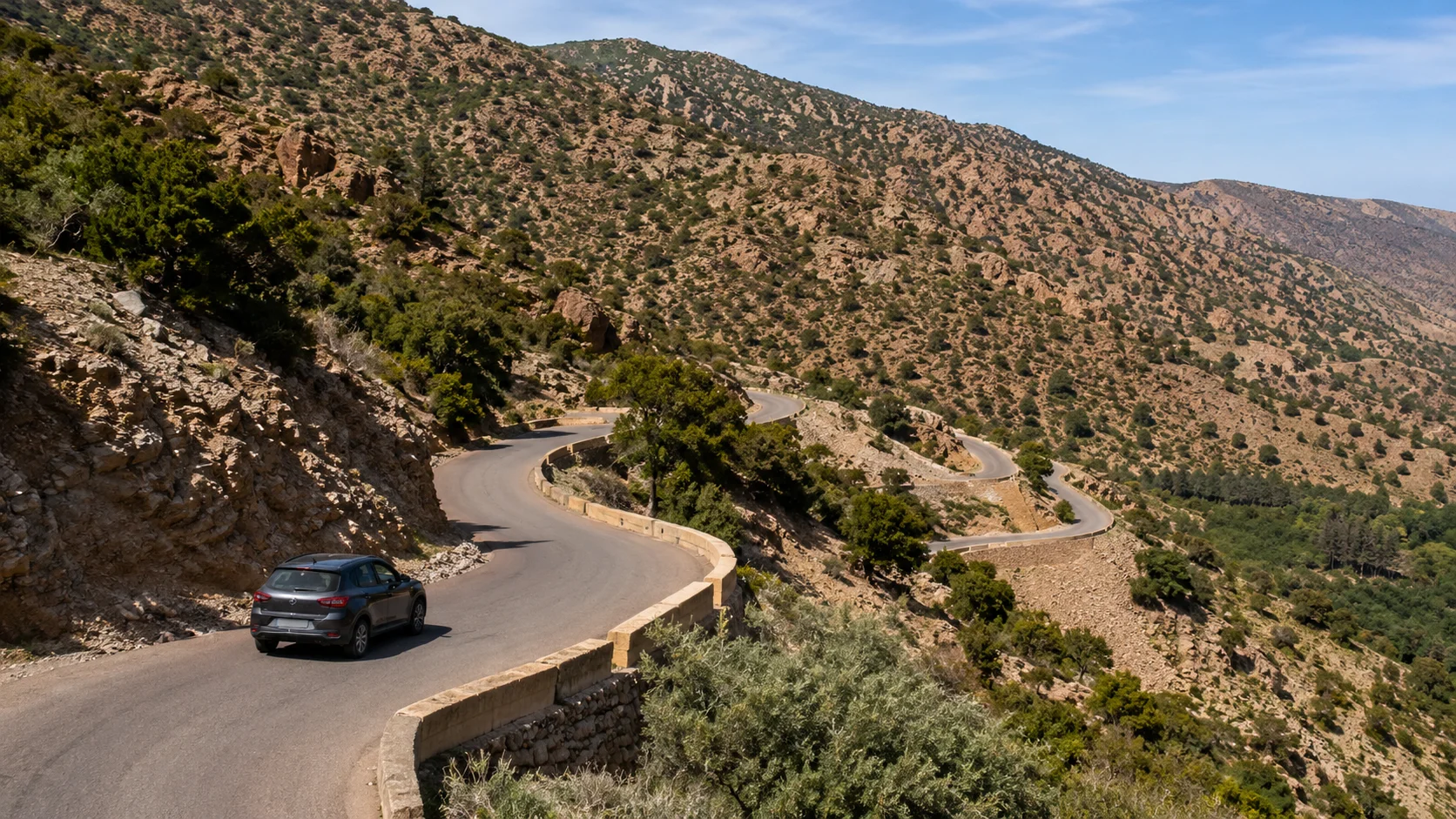
Morocco's mountains are one of the strongest reasons to rent a car, but they also require more conservative planning.
Routes through the High Atlas, Rif and Middle Atlas may take much longer than the map distance suggests.
Allow More Time Than Navigation Apps Suggest
Mountain-road travel times can change because of:
-
road construction
-
slow trucks
-
tight bends
-
weather
-
fog
-
local traffic
-
stops for viewpoints
-
snow at higher elevations
Never create a road-trip schedule that depends on arriving exactly at the fastest navigation estimate.
Do You Need an SUV?
Not automatically.
Many popular mountain destinations can be reached using ordinary paved roads.
A sedan or compact car may be perfectly adequate for routes such as Marrakech to Ouarzazate when road and weather conditions are normal.
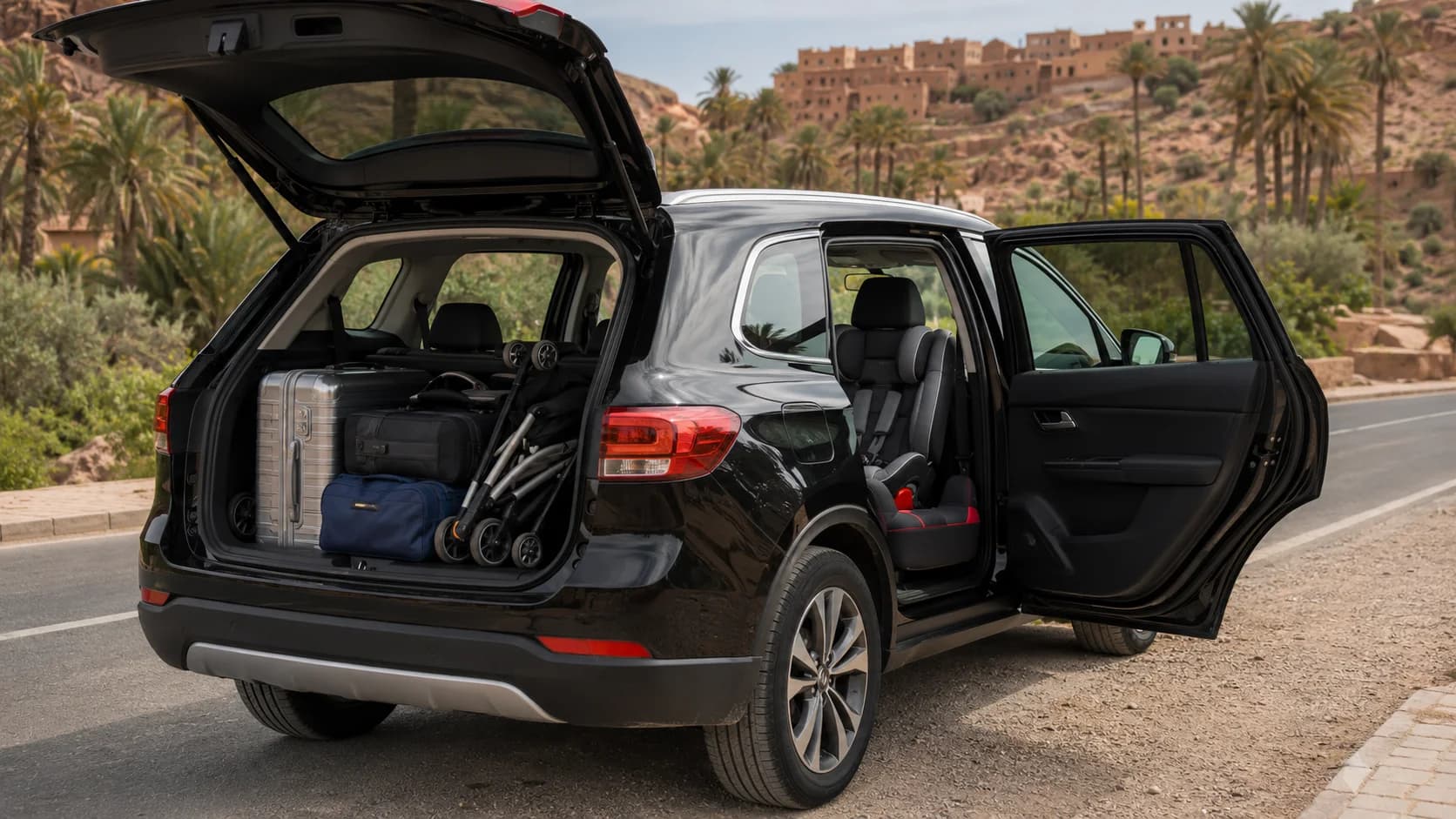
An SUV rental in Morocco becomes more useful when you need:
-
greater luggage capacity
-
higher seating position
-
more passenger space
-
greater clearance
-
additional comfort on long or uneven routes
Do not treat an SUV as permission to drive onto unsuitable tracks.
Is an Automatic Car Better for First-Time Drivers?
For many visitors, yes.
An automatic can reduce workload when dealing with:
-
busy city traffic
-
roundabouts
-
hills
-
parking
-
unfamiliar road layouts
This can be especially useful if your normal vehicle at home is automatic.
Manual transmissions remain common in Morocco, according to the Moroccan National Tourist Office.
If you prefer not to adapt to both Moroccan traffic and a manual gearbox simultaneously, book an automatic rental car in Morocco in advance.
How Do Fuel Stations Work in Morocco?
Fuel stations are common on major routes and around cities.
Petrol is generally referred to as essence, while diesel may be marked as gasoil.
Many stations are attended, meaning an employee fills the vehicle for you.
Before leaving the rental location, confirm:
-
whether your vehicle uses petrol or diesel
-
the fuel-return policy
-
where the fuel cap is opened
-
whether the tank must be returned full or at the same level
Do not wait until the warning light appears before looking for fuel in remote areas.
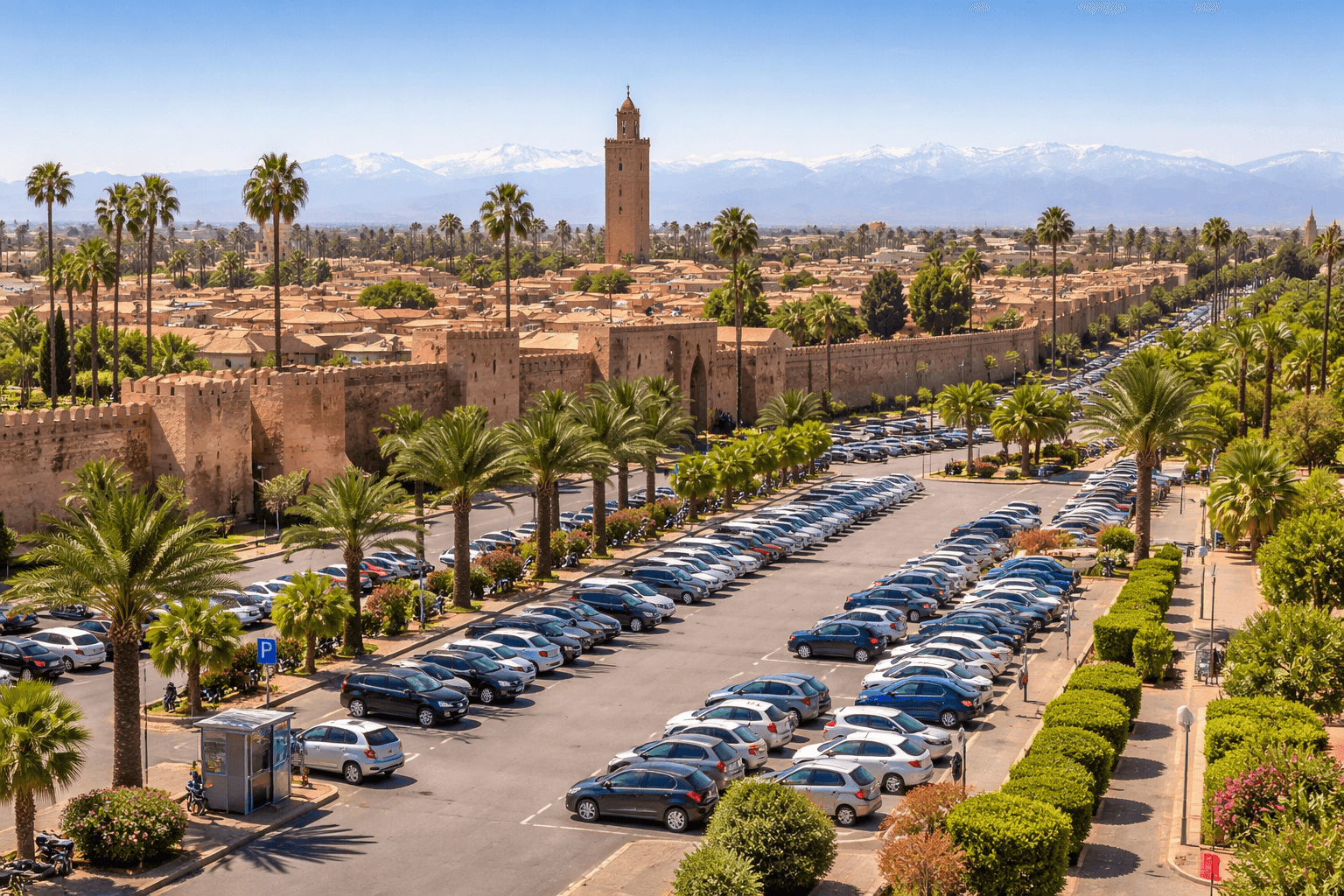
How Does Parking Work in Morocco?
Parking depends strongly on the city and neighborhood.
You may find:
-
street parking
-
guarded street spaces
-
municipal parking
-
private garages
-
hotel parking
-
shopping-centre parking
In older medinas, parking is usually located outside the pedestrian or narrow historic core.
Never Leave Important Items Visible
Take passports, money, electronics and other important valuables with you.
Put luggage in the boot before arriving at the parking location rather than visibly moving valuables after you park.
What Should You Check Before Accepting a Rental Car?
A five-minute inspection can prevent confusion when returning the vehicle.
Check:
Exterior
Look for:
-
scratches
-
dents
-
wheel damage
-
cracked lights
-
windscreen damage
Photograph or video the vehicle before leaving.
Interior
Confirm:
-
fuel level
-
dashboard warning lights
-
air conditioning
-
windows
-
mirrors
-
seat adjustment
-
phone charging
Tyres
Check the visible condition of the tyres, particularly before a long journey.
Morocco's road-safety guidance recommends checking tyre pressure, tyre condition, brakes, fluids, lights and windscreen wipers before motorway travel.
Rental Conditions
Before leaving, understand:
-
insurance coverage
-
excess
-
deposit
-
mileage allowance
-
fuel policy
-
additional-driver rules
-
roadside assistance
-
return location
-
late-return procedure
The cheapest advertised vehicle is not necessarily the best-value option if its conditions do not suit your trip.
Which Rental Car Is Best for Morocco?
Choose based on the itinerary rather than simply choosing the largest car available.
| Trip | Practical vehicle choice |
|---|---|
| Marrakech city + Essaouira | Compact or sedan |
| Casablanca + Rabat | Compact, sedan or automatic |
| Tangier + Chefchaouen | Sedan or compact |
| Long family road trip | SUV or MPV |
| Four adults + luggage | Sedan or SUV |
| Six or seven passengers | 7-seater |
| Frequent city driving | Compact automatic |
| Mountain-heavy itinerary | Sedan or SUV depending on route |
| Luxury/business travel | Premium sedan |
Budget-conscious visitors can compare cheap car rental in Morocco, but always compare insurance, mileage and deposit conditions as well as the headline rental price.
Is It Safe to Drive From Marrakech to the Sahara?
Thousands of travelers make journeys toward Ouarzazate, the Dades Valley, Tinghir and desert regions, but the route requires realistic planning.
The most important issue is not simply distance.
A journey through mountain roads involves significantly different driving conditions from a motorway trip of the same distance.
If you are traveling toward Merzouga, consider breaking the journey rather than attempting a very long single driving day immediately after arriving in Morocco.
What Should You Do at a Police Checkpoint?
Police checkpoints are part of normal road travel in Morocco.
If instructed to stop:
-
Reduce speed early.
-
Stop where directed.
-
Keep your hands visible and remain calm.
-
Have your driving documents available.
-
Follow the officer's instructions.
-
Do not attempt to drive through until you are clearly allowed to continue.
Do not photograph police, checkpoints or sensitive security locations.
What Happens if You Have an Accident?
Safety comes first.
Move out of immediate danger if it is safe and lawful to do so, then contact the rental company or insurer.
Current UK guidance states that drivers involved in an accident may need to complete a constat amiable, an accident-report form signed by both parties.
With a rental car:
-
contact the rental provider promptly
-
follow its accident procedure
-
take photographs where safe
-
record relevant vehicle details
-
do not make informal agreements that conflict with insurance instructions
What Should You Do if the Rental Car Breaks Down?
Move to a safe location wherever possible.
On a motorway:
-
get the vehicle away from live traffic if possible
-
use hazard lights
-
avoid standing in a dangerous traffic position
-
contact roadside assistance or the rental company
NARSA recommends carrying safety equipment such as a warning triangle and reflective vest for emergency stops.
Before starting a long road trip, save the rental company's roadside-assistance contact in your phone.
Five Good First-Time Driving Routes in Morocco
1. Marrakech to Essaouira
A popular first self-drive journey with a relatively straightforward connection between two major tourist destinations.
2. Casablanca to Rabat
A useful introduction to Morocco's motorway system and considerably simpler than starting with mountain roads.
3. Tangier to Asilah
A manageable northern Morocco journey that works well for travelers gaining confidence behind the wheel.
4. Agadir to Taghazout
A short coastal route that gives visitors time to become familiar with the vehicle before attempting a major road trip.
5. Fes to Ifrane
A useful introduction to driving beyond the city and toward the Middle Atlas.
Rental Car or Private Driver: Which Is Better?
Not everyone needs to self-drive.
| Choose a rental car if… | Choose a private driver if… |
|---|---|
| You want flexibility | You prefer not to navigate |
| You are planning several stops | You want door-to-door transport |
| You like road trips | You are uncomfortable with local traffic |
| You want to change plans freely | You want to work or relax during the journey |
| Your trip includes rural destinations | Your journey is mainly one intercity transfer |
Travelers who prefer not to drive can compare a private car with driver in Morocco instead.
First-Time Driving Checklist
Before leaving your hotel, airport or rental location, check that you know:
-
which side of the road to drive on
-
your next destination
-
which road you are taking
-
the fuel type
-
the posted speed limit
-
how your vehicle's lights work
-
where your rental documents are
-
how to contact roadside assistance
-
whether your route contains toll roads
-
approximately where you will refuel
-
where you plan to park when you arrive
Also download offline navigation before entering areas with weaker mobile coverage.
Good to Know Before Driving in Morocco
Drive defensively
Expect the unexpected rather than insisting on your right of way.
Do not rush
A Morocco road trip is much easier when every day has spare time built into it.
Follow signs rather than other drivers
Someone overtaking you does not mean you are driving too slowly.
Avoid fatigue
Do not plan an exhausting long-distance drive immediately after an overnight flight.
Plan medina access
Your accommodation address may be physically inside an area inaccessible to normal cars.
Keep some cash
Cards are widely useful, but cash remains practical for small expenses and some roadside situations.
Check weather before mountain journeys
Heavy rain, snow or reduced visibility can completely change the difficulty of a route.
Frequently Asked Questions About Driving in Morocco
Is driving in Morocco difficult for tourists?
Driving is generally manageable for confident drivers. Motorways and major intercity roads are usually the easiest environments. Busy urban centers, rural roads and mountain routes require more attention.
Do tourists drive on the left or right in Morocco?
Morocco drives on the right-hand side of the road. The Moroccan National Tourist Office confirms this in its transport guidance.
What is the speed limit on Moroccan motorways?
The general maximum motorway speed for normal passenger vehicles is 120 km/h, unless signs indicate a lower limit. NARSA specifically identifies 120 km/h as the motorway limit.
What is the speed limit on normal roads in Morocco?
Main roads outside urban areas are commonly limited to a maximum of around 100 km/h, while urban limits are often up to 60 km/h. Lower limits frequently apply, so always follow posted signs.
Are Moroccan motorways tolled?
Yes. Many major motorways are tolled. Autoroutes du Maroc publishes the official toll network and tariffs.
Can I pay Moroccan motorway tolls by card?
ADM states that toll payment methods include bank cards, cash, Jawaz and network cards.
Do I need an International Driving Permit in Morocco?
It depends on your nationality and licence situation. For example, UK government guidance currently requires UK visitors to carry a 1968 IDP together with their UK licence. Check the official guidance for the country that issued your licence and confirm the rental company's conditions before traveling.
Are road signs in English in Morocco?
Not necessarily. Moroccan road signs commonly use Arabic and French, although symbols, road numbers and destination names usually make major routes understandable for international drivers.
Is it safe to drive in Morocco at night?
Motorway and urban journeys may be manageable after dark, but unfamiliar rural and mountain roads deserve greater caution because pedestrians, animals, poorly illuminated vehicles and road hazards may be harder to see.
Do I need an SUV to drive around Morocco?
No. Most standard tourist routes use paved roads that can be driven with a compact car or sedan. An SUV can be useful for luggage, passenger space, clearance and certain more demanding itineraries, but it is not automatically necessary.
Is an automatic car worth renting in Morocco?
For first-time visitors who normally drive an automatic, it can be. Reducing the need for gear changes makes city traffic, hills and unfamiliar roads easier to manage.
Can tourists drive from Marrakech to Merzouga?
Yes, but it is a long journey and is better planned as a multi-stage road trip. Routes through the Atlas and southeast Morocco should be scheduled around daylight, weather, road conditions and realistic rest stops.
Can I rent a car at a Moroccan airport?
Yes. Car rental is widely available around Morocco's major airports. The Moroccan National Tourist Office notes that rental-car agencies are among the transport options available to visitors arriving at airports.
Final Advice for Driving in Morocco for the First Time
Driving in Morocco gives tourists something organized transport cannot always provide: the freedom to change route, stop in smaller towns, explore the Atlantic coast, cross mountain regions and connect destinations on their own schedule.
The key is not to drive as if you were at home.
Drive according to the environment in front of you.
Follow posted limits, keep extra distance, expect pedestrians and scooters, avoid overloading your itinerary, plan mountain journeys carefully and leave time for unexpected delays.
For first-time visitors, the easiest strategy is often to begin with a straightforward drive, become familiar with the vehicle and local road behavior, and then move on to longer intercity or mountain routes.
If your itinerary includes several destinations, compare car rental options across Morocco with MarHire and choose the vehicle based on passengers, luggage, route and driving comfort rather than price alone.