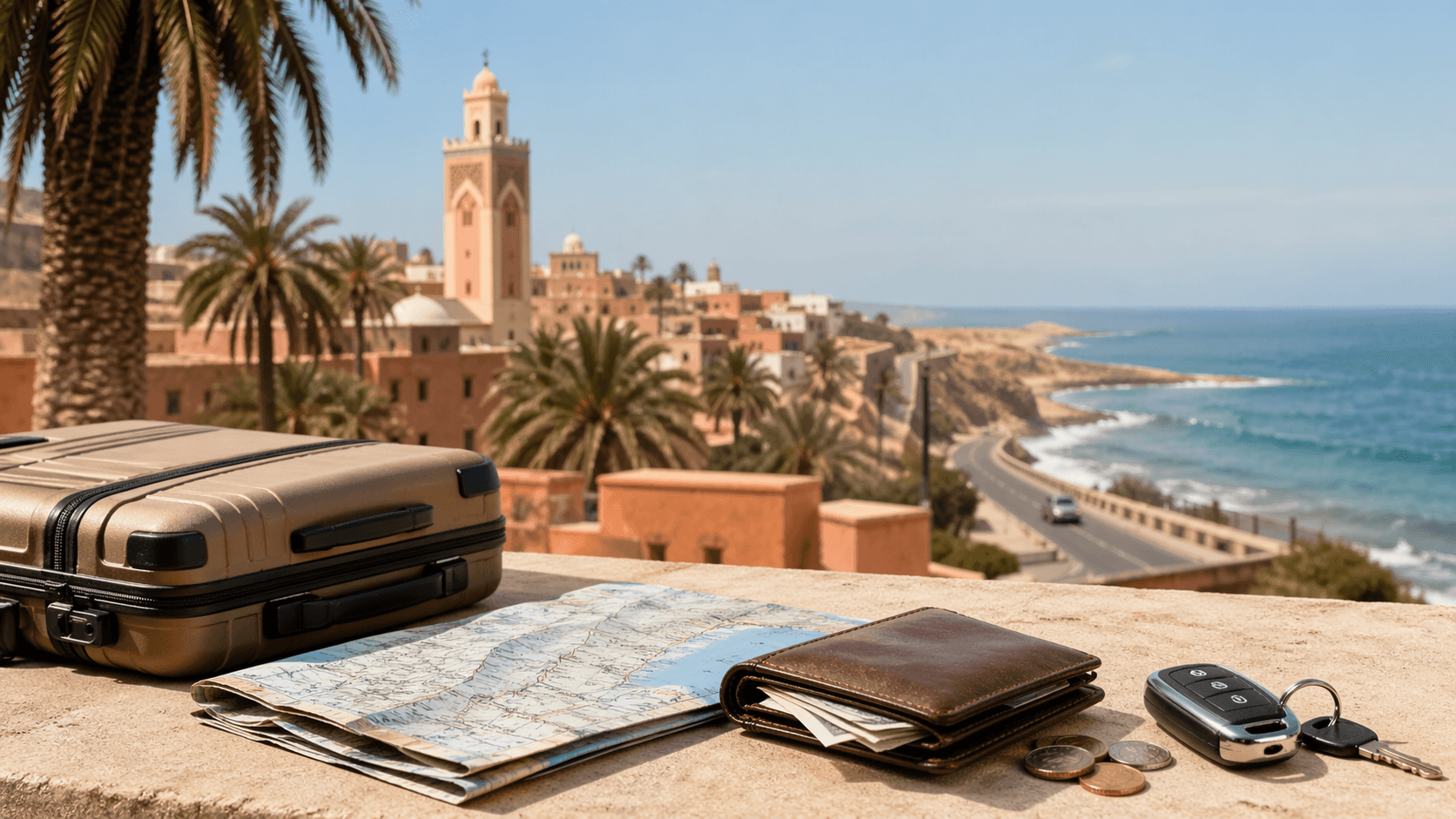







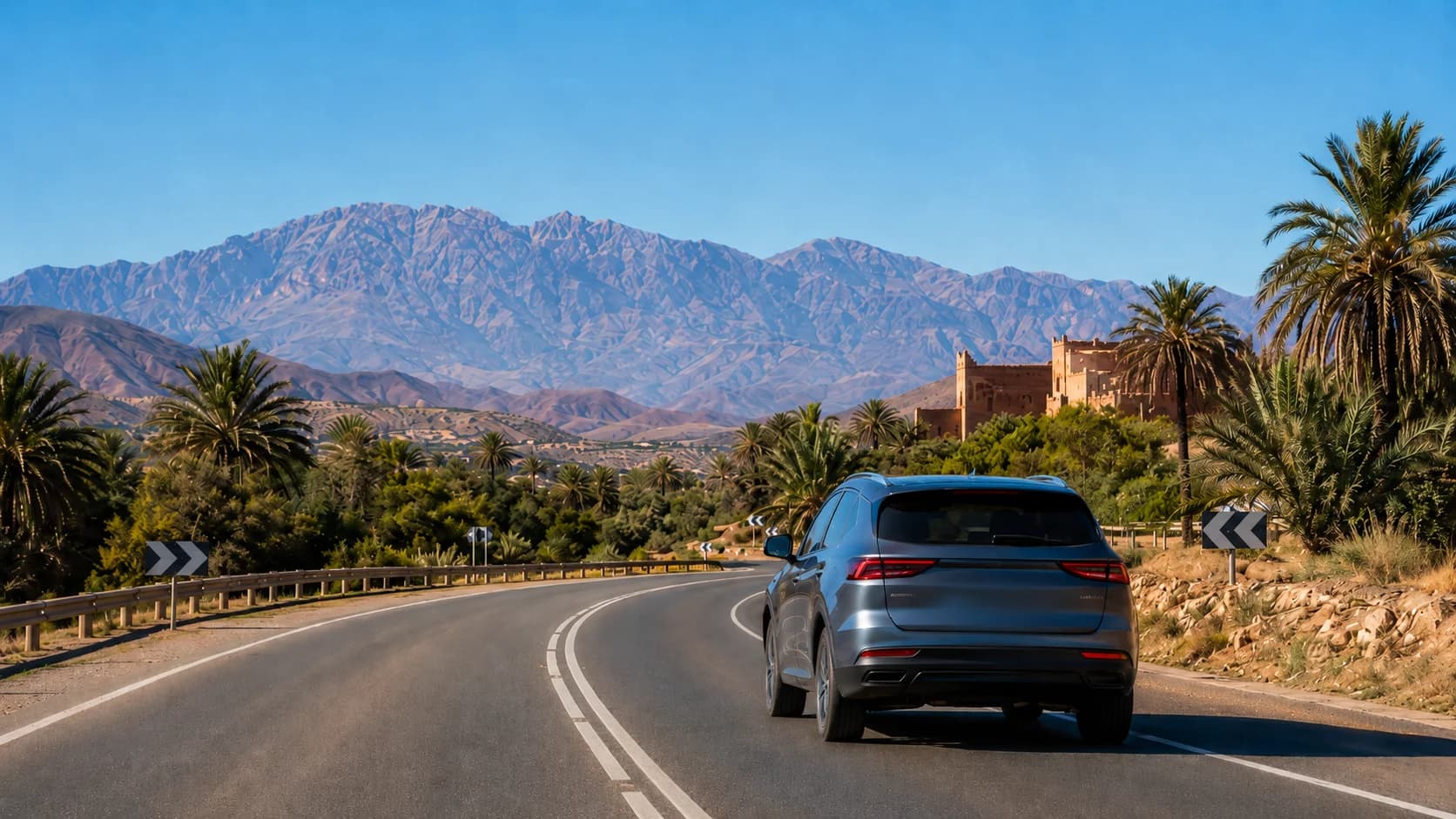
Driving in Morocco as an American tourist is entirely possible and can be one of the most flexible ways to explore the country. U.S. visitors can drive with a valid American driver's license during a normal tourist stay, Morocco drives on the right-hand side of the road, and major cities are connected by a modern highway network. However, traffic behavior, police checkpoints, mountain roads, parking and road conditions can feel different from driving in the United States.
This guide explains what American tourists should know before renting a car in Morocco, including license requirements, road rules, speed limits, toll roads, fuel, police stops, insurance, city traffic and long-distance driving.
Table of Contents
- U.S. driver's license requirements
- International Driving Permits
- Renting a car in Morocco as an American
- Right-hand driving and Moroccan road signs
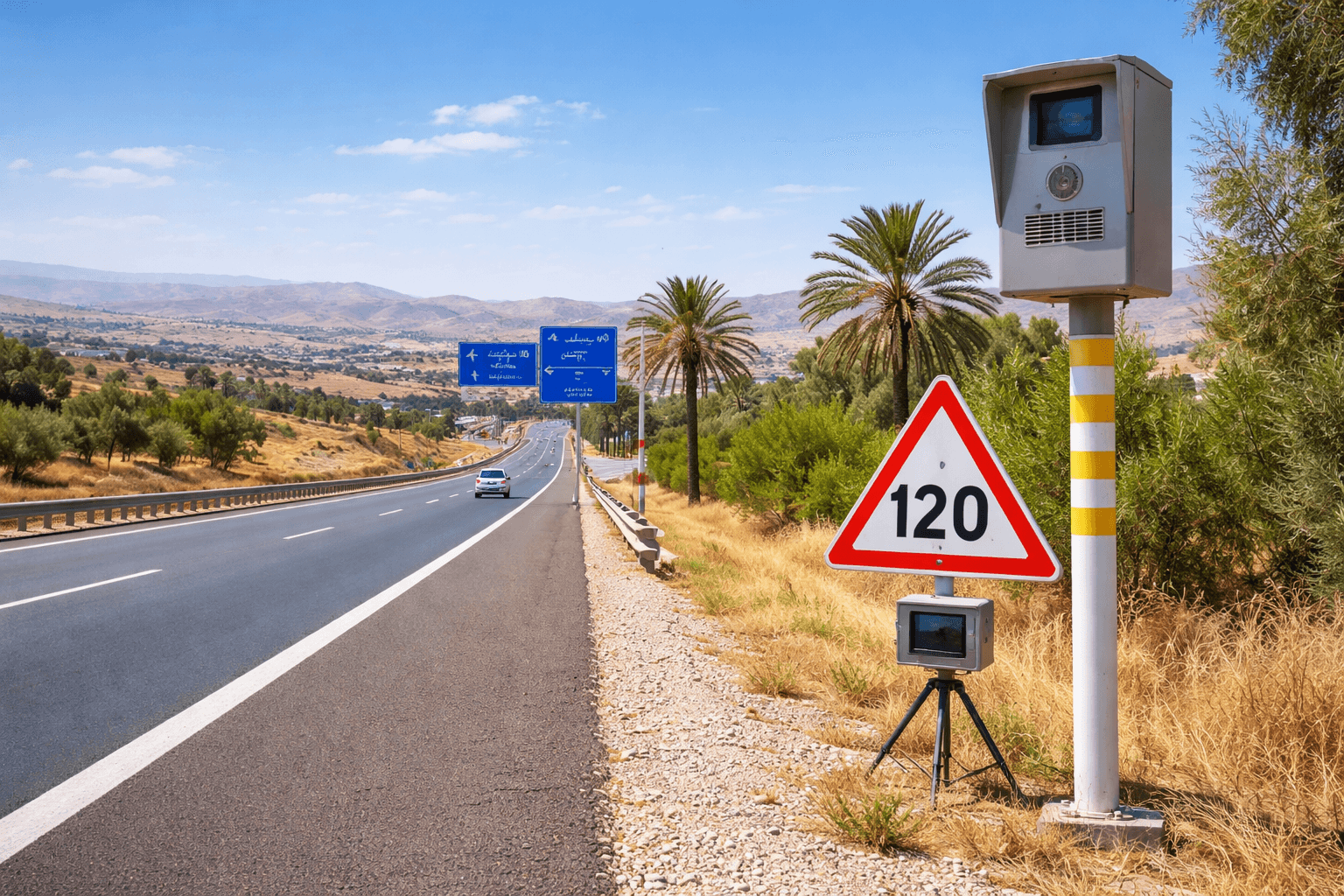
- Speed limits and radar controls
- Police checkpoints
- Highways and toll roads
- City driving
- Mountain and rural roads
- Night driving
- Parking
- Fuel stations
- Insurance
- Accidents and emergencies
- Choosing the right rental vehicle
- Best Morocco road trips
- Frequently asked questions
Can Americans Drive in Morocco?
Yes. American tourists can legally drive in Morocco with a valid U.S. driver's license during a short visit. Current U.S. State Department guidance states that foreign driver's licenses can be used in Morocco for up to one year. Carry your original license and passport when driving. An International Driving Permit is not generally necessary for a standard U.S. license during a tourist rental, although obtaining one can provide a useful translated backup document. Rental-company requirements can vary.
Morocco drives on the right side of the road, as in the United States. Major highways are generally straightforward, but drivers should expect more scooters, pedestrians, roadside activity and police controls than they may be accustomed to at home.
Driving in Morocco at a Glance for Americans
| Question | What American Tourists Should Know |
|---|---|
| Can Americans drive in Morocco? | Yes, with a valid U.S. driver's license during a tourist visit |
| International Driving Permit | Usually not necessary for a standard U.S. license, but useful as backup |
| Side of road | Right |
| Vehicle position | Steering wheel normally on the left |
| Common city speed limit | Often up to 60 km/h, subject to posted signs |
| Common national-road limit | Often up to 100 km/h, subject to posted signs |
| Motorway maximum | Commonly up to 120 km/h, subject to posted signs |
| Motorways | Toll roads are common |
| Police checkpoints | Common in cities and on intercity routes |
| Fuel | Petrol and diesel widely available |
| Night driving | Best minimized on rural and mountain routes |
| Main tourist road-trip cities | Marrakech, Casablanca, Rabat, Tangier, Fes, Agadir and Essaouira |
The posted road sign always takes priority over a general speed-limit guideline.
Do Americans Need an International Driving Permit in Morocco?
For a normal tourist visit, an American traveler can use a valid U.S. driver's license in Morocco. The U.S. State Department's current Morocco guidance states that foreign licenses are valid for use in the country for up to one year.
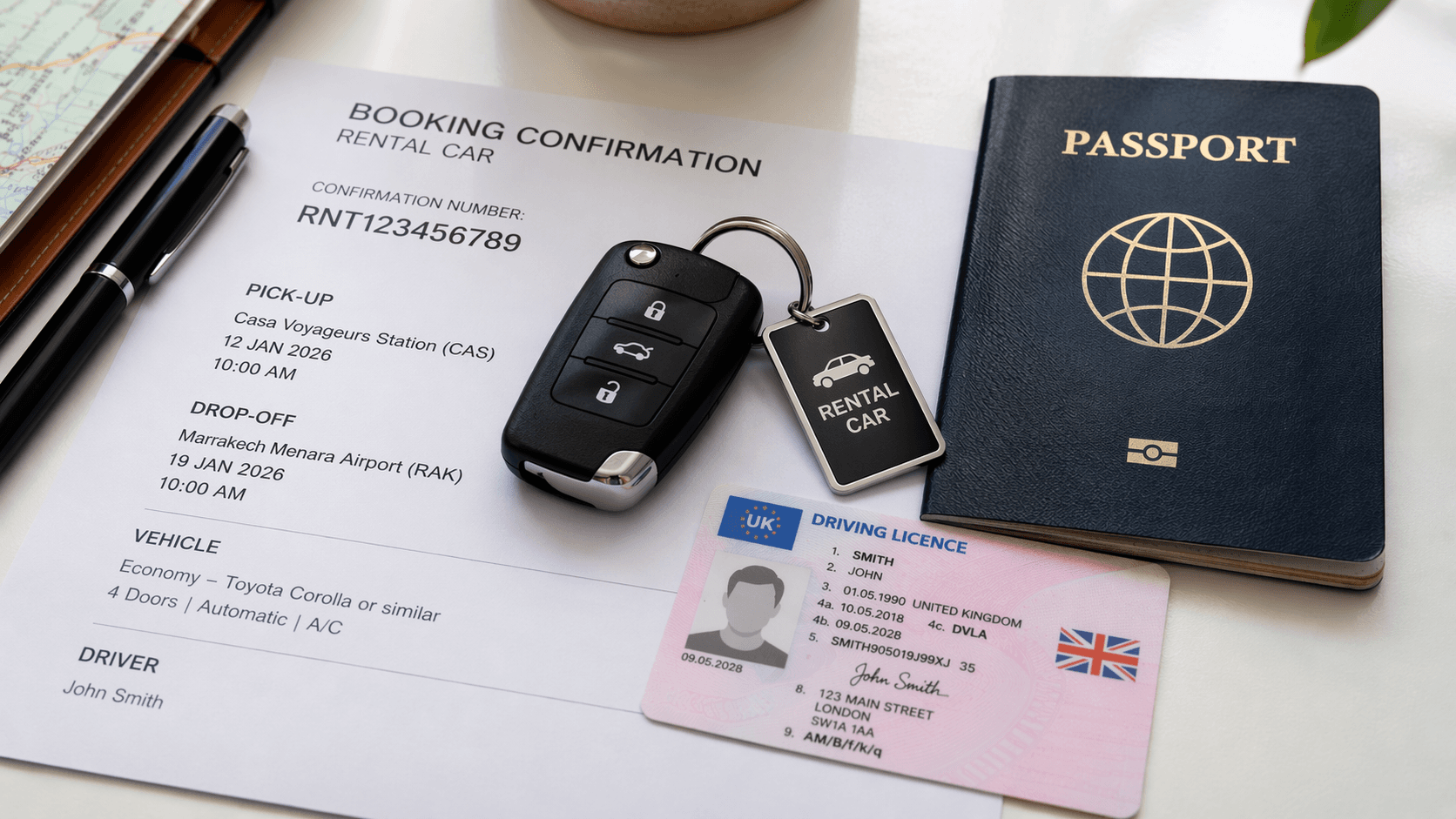
For most American travelers, therefore, the essential documents are:
-
original valid U.S. driver's license
-
passport
-
rental agreement
-
vehicle documentation
-
proof of applicable insurance
An International Driving Permit, commonly called an IDP, can still be useful because it provides a standardized translation of your license.
If you decide to get one before leaving the United States, use an authorized issuer. The U.S. Department of State identifies AAA and AATA as authorized U.S. IDP issuers and warns travelers about websites selling invalid international permits.
An IDP does not replace your American driver's license. If carrying one, bring both documents.
What Do Americans Need to Rent a Car in Morocco?
Requirements depend on the rental company and vehicle category, but American tourists normally need:
-
A valid U.S. driver's license
-
A passport
-
A license held for the rental company's minimum required period
-
A payment method accepted by the selected provider
-
Any additional documentation specified in the confirmed rental conditions
Minimum driver ages are not identical across all vehicles. Economy cars may have different requirements from premium SUVs or luxury vehicles.
When comparing car rental in Morocco, look beyond the daily price and check:
-
insurance
-
excess or deductible
-
security deposit
-
mileage allowance
-
fuel policy
-
extra-driver conditions
-
airport delivery
-
one-way return rules
-
roadside support
-
exact vehicle category
MarHire lists rental options across Marrakech, Casablanca, Tangier, Fes, Rabat, Agadir and Essaouira, including economy cars, automatics, SUVs, family vehicles and selected no-deposit options.
Is Driving in Morocco Similar to Driving in the United States?
Some basic rules will feel familiar.
Moroccans drive on the right, and most vehicles have the steering wheel on the left. Modern highways use internationally recognizable road markings and signs.
The biggest adjustment is not which side of the road you use. It is the surrounding traffic environment.
American visitors may encounter:
-
scooters filtering between vehicles
-
pedestrians crossing outside marked crossings
-
bicycles
-
slower vehicles
-
taxis stopping unexpectedly
-
roadside vendors
-
animals or animal-drawn vehicles outside cities
-
drivers changing lanes with less space than an American driver might expect
The U.S. State Department specifically notes that pedestrians, scooters and animal-drawn vehicles can appear on Moroccan roads, including major routes.
The safest strategy is defensive driving: leave space, anticipate movement around you and avoid assuming another road user will behave exactly as they would in the United States.
What Are the Speed Limits in Morocco?
Common reference limits for passenger cars are:
| Road Type | Common Maximum |
|---|---|
| Urban areas | Up to 60 km/h |
| Roads outside cities | Up to 100 km/h |
| Motorways | Up to 120 km/h |
These are general reference points, not substitutes for signs. Lower limits are common near residential areas, schools, intersections, roadworks and town entrances.
Speed enforcement is important in Morocco.
Fixed or mobile radar controls may operate along intercity routes, and police or gendarmerie officers regularly monitor traffic.
The U.S. State Department notes that if you are stopped for speeding, you can request the evidence documenting the violation. It also describes procedures for paying or contesting traffic fines.
For an American tourist, the simplest rule is:
Do not drive according to how fast the surrounding traffic is moving. Drive according to the posted limit.
Are Police Checkpoints Common in Morocco?
Yes.
Police and gendarmerie checkpoints are normal in Morocco, particularly:
-
at city entrances
-
near major junctions
-
on intercity roads
-
around sensitive areas
-
along popular tourist routes
The State Department confirms that Moroccan police frequently stop drivers for inspection in cities and on highways.
Seeing a checkpoint does not mean something is wrong.
Slow down, follow the officer's signal and have your driving documents accessible.
You may be asked for your:
-
driver's license
-
passport or identification
-
vehicle registration
-
rental documents
Do not try to drive through a checkpoint unless an officer clearly directs you to continue.
Are Moroccan Highways Good?
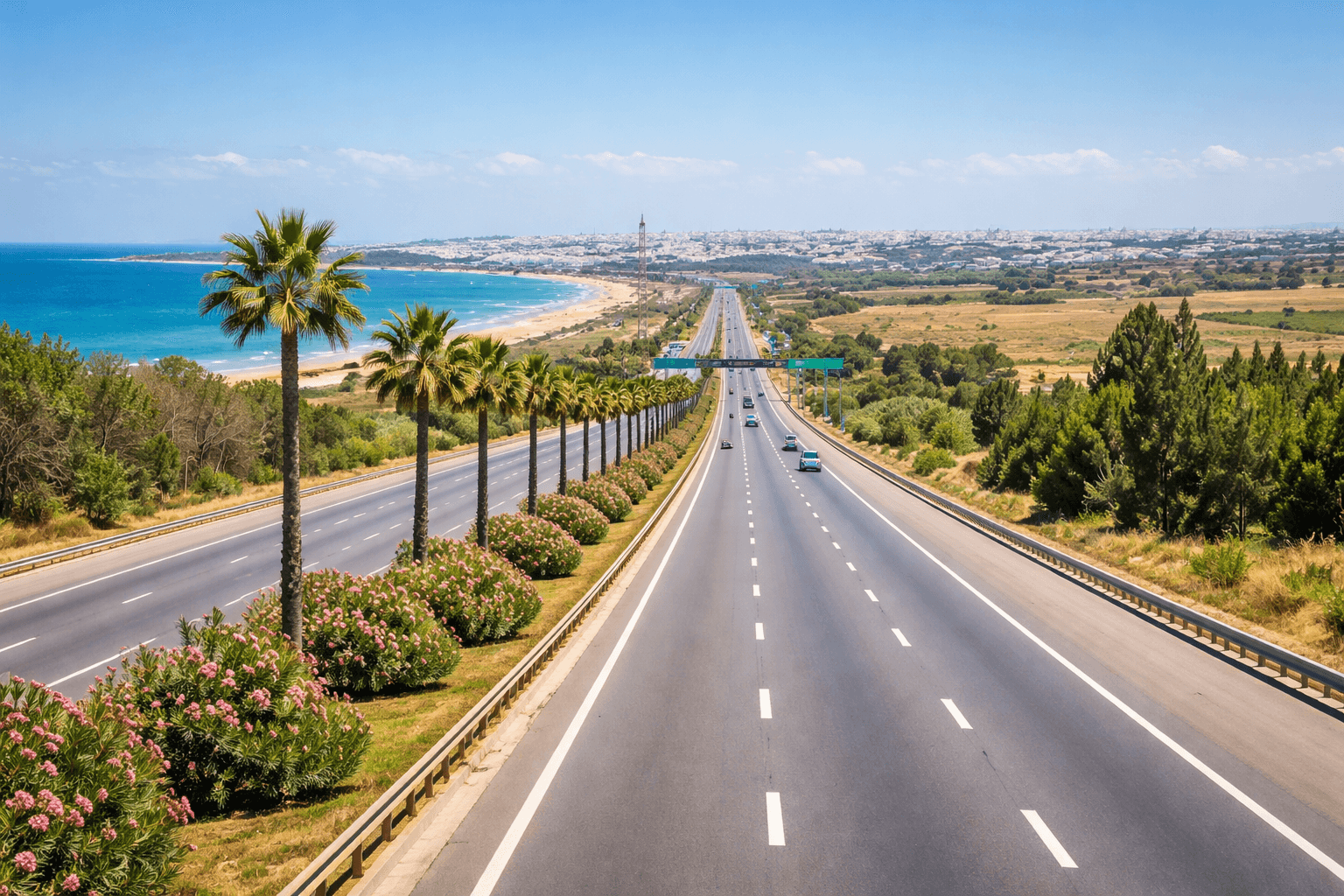
The primary motorway network is one of the easiest parts of driving in Morocco.
Modern freeways connect important destinations including:
-
Tangier
-
Rabat
-
Casablanca
-
Fes
-
Marrakech
The U.S. State Department describes modern freeways connecting these major cities, while other destinations are reached by two-lane roads.
For an American traveler planning a first Morocco road trip, motorway journeys such as Casablanca to Rabat or Casablanca to Marrakech are generally less demanding than driving through a dense medina district or a remote mountain road.
How Do Toll Roads Work in Morocco?
Many Moroccan motorways charge tolls.
Morocco's motorway network is managed by Autoroutes du Maroc, commonly abbreviated ADM. The network also uses Jawaz, an electronic toll-payment system with dedicated lanes.
Toll prices depend on the section of motorway and vehicle class. Official ADM tariff information lists different charges for routes throughout the motorway network.
If your rental vehicle does not include an electronic toll solution, follow the normal toll lanes and payment instructions at the station.
Before a long trip, carrying some Moroccan dirhams is sensible even if you normally rely on cards.
Check Morocco motorway information with Autoroutes du Maroc
What Is Driving in Marrakech Like?
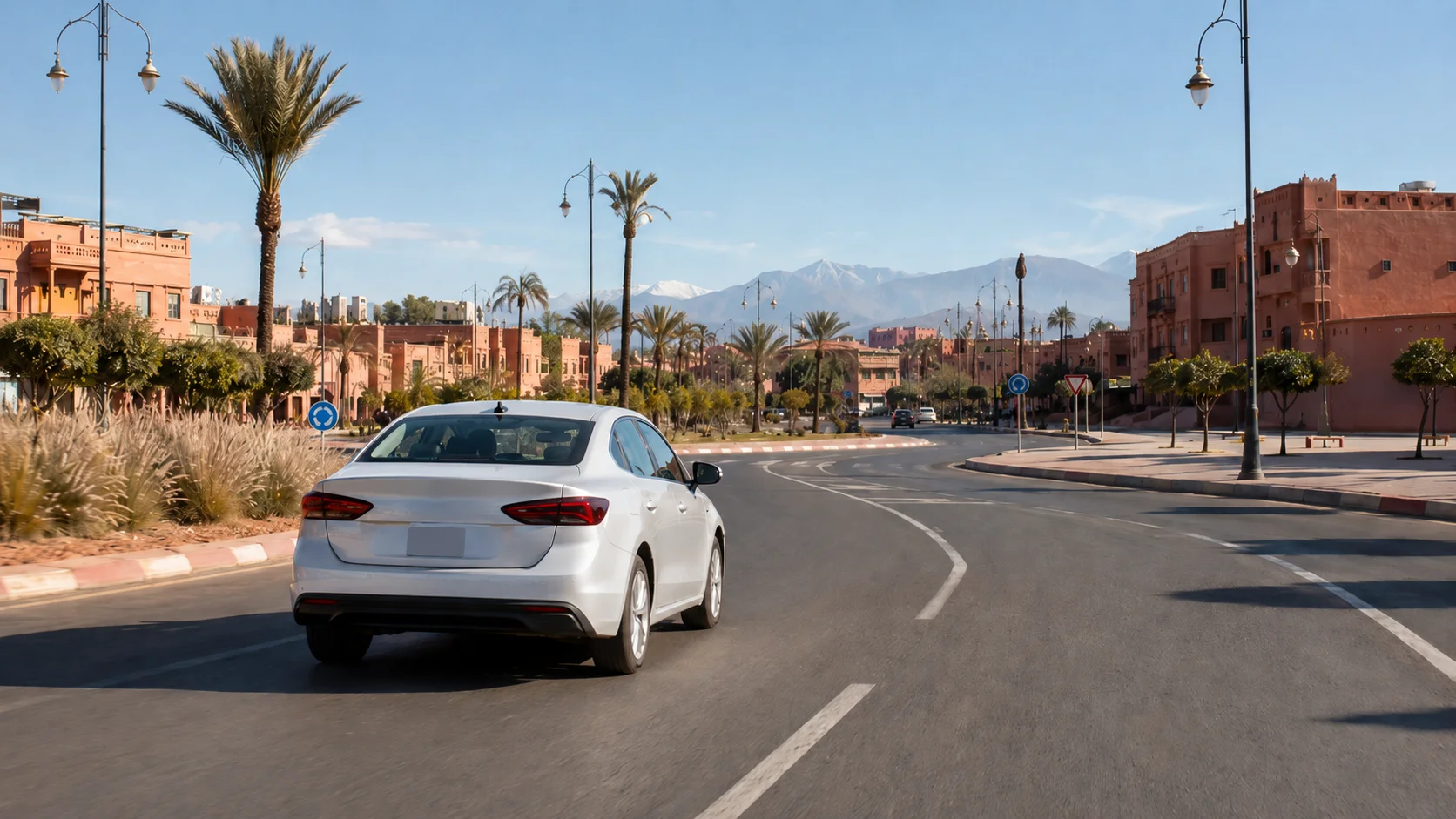
Marrakech can initially feel busy to an American driver.
Expect:
-
scooters
-
taxis
-
pedestrians
-
roundabouts
-
tourist coaches
-
changing traffic density
-
narrow streets near older neighborhoods
The historic medina is not where a visitor should expect conventional door-to-door car access. If your accommodation is inside or beside the medina, confirm the closest practical parking or meeting point.
A compact or automatic vehicle can make city driving easier.
Travelers starting their road trip here can compare car rental in Marrakech, including options for airport arrivals and onward journeys toward Essaouira, the Atlas Mountains, Casablanca or Agadir.
What Is Driving in Casablanca Like?
Casablanca is a very different driving environment from Marrakech.
It is Morocco's largest urban area and has:
-
multi-lane boulevards
-
dense commuter traffic
-
major intersections
-
trams
-
taxis
-
motorway connections
-
busy approaches around Mohammed V International Airport
Driving is manageable, but first-time visitors should give themselves more time around peak traffic periods and avoid making last-second lane changes.
Casablanca is also an excellent starting point for longer drives because of its highway connections toward Rabat, Tangier, Fes and Marrakech.
American travelers arriving at CMN can compare Casablanca airport car rental options before planning an intercity road trip.
What About Tangier, Fes, Agadir and Essaouira?
Driving conditions vary significantly between Morocco's major tourist cities.
Tangier combines hills, coastal roads, busy central streets and useful highway access south toward Rabat and Casablanca.
Fes requires extra planning around the old medina. Fes el-Bali is primarily explored on foot, so visitors staying inside the medina should identify an accessible parking or accommodation meeting point.
Agadir generally has wider streets and is often one of the easier major Moroccan destinations for tourists getting accustomed to driving.
Essaouira is compact, but the historic walled medina is largely pedestrian-oriented. Parking outside the central old-city area is normally more practical than trying to drive to a riad door.
Understanding that distinction is important: renting a car gives you freedom between destinations, but it does not mean every Moroccan accommodation can be reached directly by vehicle.
Are Rural Roads and Mountain Roads Safe?
Conditions can change significantly once you leave the primary highway network.
The State Department advises that some rural secondary roads are narrow or poorly paved and describes roads through the Rif and Atlas Mountains as steep, narrow and winding.
That does not mean tourists should avoid Morocco's mountains.
It means route planning matters.
Before driving into the High Atlas, Middle Atlas or Rif:
-
check the weather
-
leave during daylight
-
keep adequate fuel
-
allow extra travel time
-
do not rely blindly on the fastest GPS route
-
choose a vehicle appropriate for your route
-
avoid unplanned remote shortcuts
A paved main road does not automatically require a 4x4. However, an SUV or higher-clearance vehicle may provide additional comfort on rougher routes or longer journeys.
Should American Tourists Drive in Morocco at Night?
Whenever possible, complete unfamiliar rural and mountain routes during daylight.
The U.S. State Department specifically recommends extreme caution when driving at night because of poor lighting on some roads.
Night driving may also make it harder to see:
-
pedestrians
-
cyclists
-
animals
-
unlit or poorly lit vehicles
-
road edges
-
potholes
-
unexpected roadside activity
Urban driving after dark on familiar, well-lit roads is different from beginning a remote mountain journey after sunset.
If your flight arrives late, consider staying locally the first night rather than immediately starting a long cross-country drive.
What Happens During Rain or Bad Weather?
Weather deserves more attention than many visitors expect.
The rainy season can affect road conditions, particularly outside urban centers. The State Department warns of flash flooding from roughly November through March and notes that serious flooding can affect rural roads.
Mountain conditions can also vary by altitude and season.
If the road ahead is flooded, do not assume it is safe simply because another vehicle tries to cross.
For routes involving the Atlas Mountains or remote areas, check current conditions before departure.
How Does Parking Work in Morocco?
Parking varies by city and neighborhood.
Common options include:
-
hotel parking
-
private parking garages
-
street parking
-
designated parking areas near medinas
-
managed outdoor lots
Around historic centers, it is often easier to park outside the pedestrian core and continue on foot.
Before booking accommodation, ask:
-
Can a car reach the property?
-
Is private parking available?
-
If not, where is the closest suitable parking?
-
Is overnight parking permitted?
Do not leave passports, electronics, bags or other valuables visible inside a parked vehicle. The State Department warns that theft from vehicles can occur and recommends keeping valuables out of sight.
Are Gas Stations Easy to Find?
Yes, fuel stations are widely available in Moroccan cities and along primary intercity routes.
Rental vehicles may use either:
-
gasoline/petrol
-
diesel
Confirm the fuel type before leaving the pickup point.
Do not assume based on the vehicle's appearance.
For long drives into mountains or sparsely populated regions, fill up before leaving a major town rather than waiting until the tank is nearly empty.
Also confirm your rental fuel policy. A same-to-same policy, for example, means returning the car with approximately the same fuel level as at pickup.
Does U.S. Car Insurance Cover Driving in Morocco?
Do not assume it does.
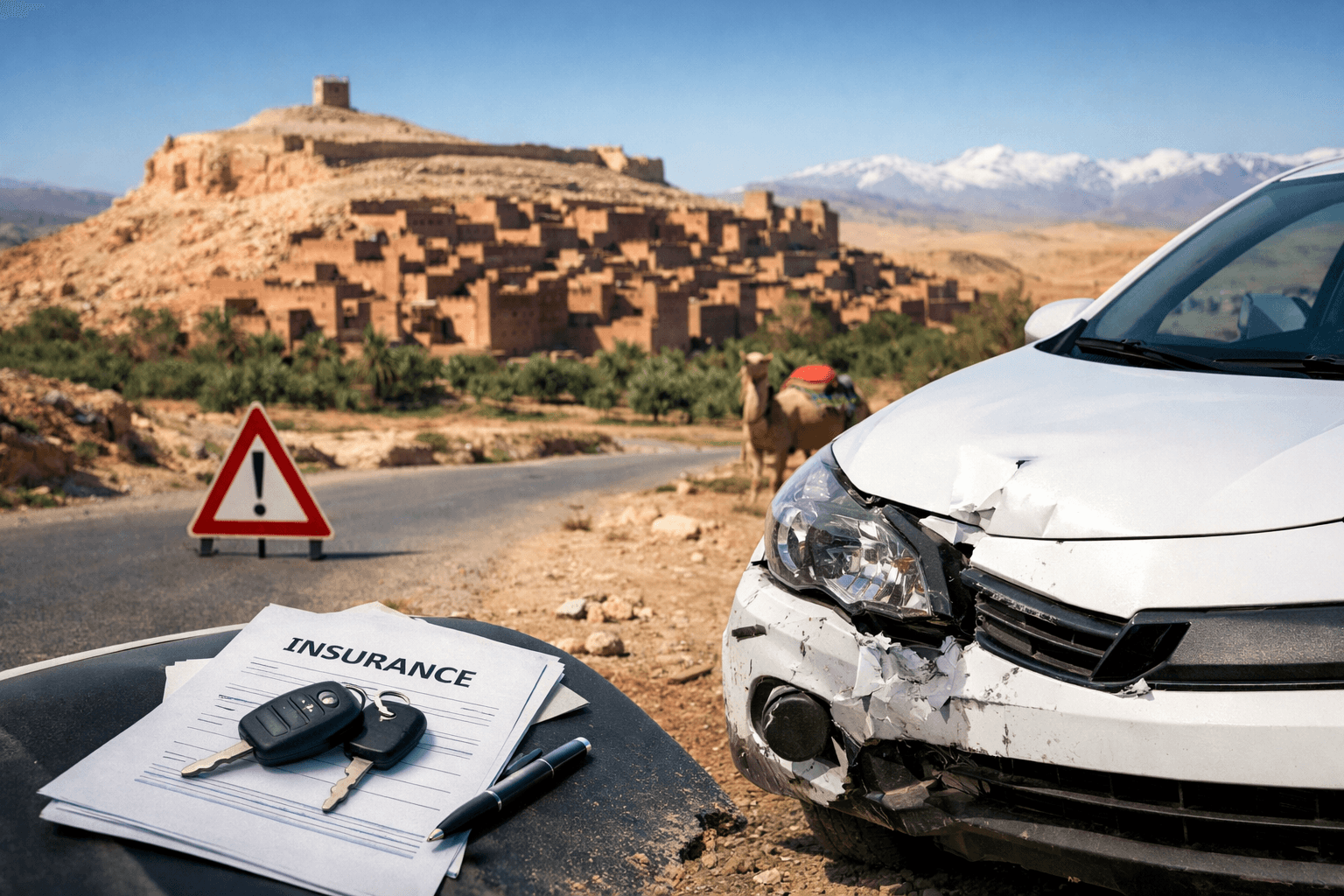
The U.S. State Department warns that American auto insurance policies may not cover driving abroad and recommends confirming coverage before traveling. It also advises travelers to review the rental company's insurance carefully.
When renting in Morocco, understand the difference between:
-
included insurance
-
collision coverage
-
theft protection
-
excess or deductible
-
security deposit
-
exclusions
-
tire or glass coverage
-
zero-excess options
Before leaving the pickup location, photograph or video the vehicle condition and make sure existing damage is documented.
For MarHire rentals, the applicable protection plan, deposit, excess and other conditions should be reviewed on the selected vehicle and confirmed booking rather than assumed from another rental.
What Should You Do After an Accident in Morocco?
If an accident occurs, prioritize safety and follow local procedures.
The U.S. State Department states that parties involved in an accident are required to remain at the scene. It also advises not moving the vehicle until police or the insurance investigator have documented the necessary information.
You should also contact your rental provider immediately.
Keep copies or photographs of:
-
rental documentation
-
insurance information
-
driver's license
-
passport identification page
-
emergency contacts
For serious situations involving a U.S. citizen, the U.S. Consulate General in Casablanca can also provide consular assistance.
Review the current U.S. State Department Morocco travel guidance
What Type of Rental Car Is Best for an American Tourist?
The best vehicle depends much more on your route than on the idea that Morocco automatically requires an SUV.
| Trip Type | Practical Vehicle Choice |
|---|---|
| Marrakech city stay | Compact or automatic |
| Casablanca and Rabat | Compact, sedan or automatic |
| Casablanca to Marrakech | Sedan or compact |
| Multi-city road trip | Sedan, automatic or SUV |
| Couple with light luggage | Economy or compact |
| Family with luggage | SUV or larger family vehicle |
| 6–7 travelers | 7-seater / MPV |
| Atlas or Rif touring | SUV depending on route |
| Remote demanding terrain | Suitable 4x4 where actually required |
For most paved tourist itineraries, a normal passenger car is sufficient.
An SUV becomes more useful when you want:
-
additional luggage capacity
-
a higher driving position
-
more passenger space
-
greater comfort on long routes
-
extra clearance on rougher roads
American drivers who normally use automatics should also check transmission carefully when booking. Manual cars remain common in Morocco.
Which Morocco Road Trips Work Well With a Rental Car?
A rental car becomes particularly valuable when your itinerary extends beyond one city.
Popular combinations include:
Casablanca to Rabat
A straightforward intercity drive using the motorway network and a practical introduction to Moroccan highway driving.
Marrakech to Essaouira
A popular road trip connecting Marrakech with Morocco's Atlantic coast.
Marrakech to Agadir
Useful for travelers combining Marrakech with southern Atlantic destinations.
Tangier to Chefchaouen
A scenic northern Morocco journey toward the Rif Mountains, requiring more attention than a motorway-only trip.
Fes to Chefchaouen
Another popular northern route with changing terrain and mountain sections.
Fes to Merzouga
A much longer journey requiring realistic driving-time planning and an overnight-oriented itinerary.
The biggest benefit of driving is the ability to stop when you choose rather than planning your trip entirely around train or bus schedules.
Is Renting a Car in Morocco Worth It for Americans?
It depends on your itinerary.
A rental car is particularly useful if you plan to:
-
visit several Moroccan cities
-
explore coastal towns
-
travel through the Atlas or Rif regions
-
reach destinations with limited train connections
-
carry substantial luggage
-
set your own departure times
-
make spontaneous stops
You may not need a rental car if your trip consists only of several days inside one medina or if your itinerary links only destinations well served by trains.
A good compromise is often to rent the vehicle only for the road-trip portion of the vacation.
Practical Tips for American Drivers in Morocco
Before starting your journey:
-
Keep your original U.S. license with you.
-
Carry your passport and rental documents.
-
Save offline maps.
-
Verify whether your car is petrol or diesel.
-
Learn the vehicle controls before leaving the pickup point.
-
Check the transmission when booking.
-
Follow posted speed limits carefully.
-
Slow down well before police checkpoints.
-
Expect scooters and pedestrians around cities.
-
Avoid unnecessary nighttime driving on rural roads.
-
Leave valuables out of sight when parking.
-
Check weather before mountain routes.
-
Keep some Moroccan dirhams available.
-
Confirm toll, insurance, deposit and mileage conditions before departure.
-
Never blindly follow GPS onto an unsuitable rural shortcut.
The State Department also cautions travelers that the fastest GPS-recommended route is not necessarily the safest.
Frequently Asked Questions
Can I drive in Morocco with a U.S. driver's license?
Yes. Current U.S. State Department guidance states that foreign driver's licenses are valid in Morocco for up to one year. A normal American tourist should carry the original valid U.S. license while driving.
Do Americans need an International Driving Permit in Morocco?
A valid U.S. license can be used during a short tourist visit, so an IDP is generally not necessary solely because you are American. However, an IDP can provide a translated backup, and individual rental companies may impose additional documentation requirements.
Is Morocco left-hand or right-hand drive?
Vehicles drive on the right-hand side of the road, the same side used in the United States.
Is it difficult for Americans to drive in Morocco?
Driving on modern motorways is generally straightforward. Dense city traffic, scooters, pedestrians, mountain roads and local driving habits require more attention. First-time visitors should drive defensively and allow extra time.
Are there speed cameras in Morocco?
Speed is actively enforced through police controls and radar. Always follow the posted limit rather than simply matching surrounding traffic. The State Department provides specific information about procedures when a driver is stopped for speeding.
Are there police checkpoints in Morocco?
Yes. Police and gendarmerie checkpoints are common around cities and on intercity roads. Slow down and follow officers' instructions.
Can I drive from Marrakech to the Sahara?
Yes, but destinations such as Merzouga require a substantial road journey rather than a quick excursion. Build a multi-day itinerary, plan daylight driving and check road and weather conditions.
Do I need a 4x4 to drive around Morocco?
Not for normal paved routes between major tourist destinations. Economy cars, sedans and SUVs can handle most conventional road trips. A true 4x4 becomes relevant for specific rough or remote routes.
Should an American Tourist Drive in Morocco?
For many travelers, yes.
Driving in Morocco as an American tourist can be a practical way to explore Marrakech, Casablanca, Rabat, Tangier, Fes, Agadir, Essaouira and destinations beyond the main rail network. The most important differences are not the side of the road but traffic behavior, police controls, mountain conditions, medina access and the need for more defensive driving.
Bring your original U.S. driver's license and passport, choose a rental appropriate for the route, review your insurance carefully, follow posted speed limits and complete unfamiliar rural journeys during daylight whenever possible.
With realistic planning, a self-drive trip gives American visitors considerably more freedom to explore Morocco beyond the main city centers.
Plan Your Morocco Road Trip With MarHire
Planning a self-drive trip across Morocco? Compare MarHire car rental options throughout Morocco for airport arrivals, city stays and longer road trips. Vehicle choices include economy cars, automatic models, sedans, SUVs and family vehicles, with rental conditions shown for the selected booking.
For city-specific arrivals, you can also explore Marrakech car rental or Casablanca airport car rental before building your Morocco itinerary.