


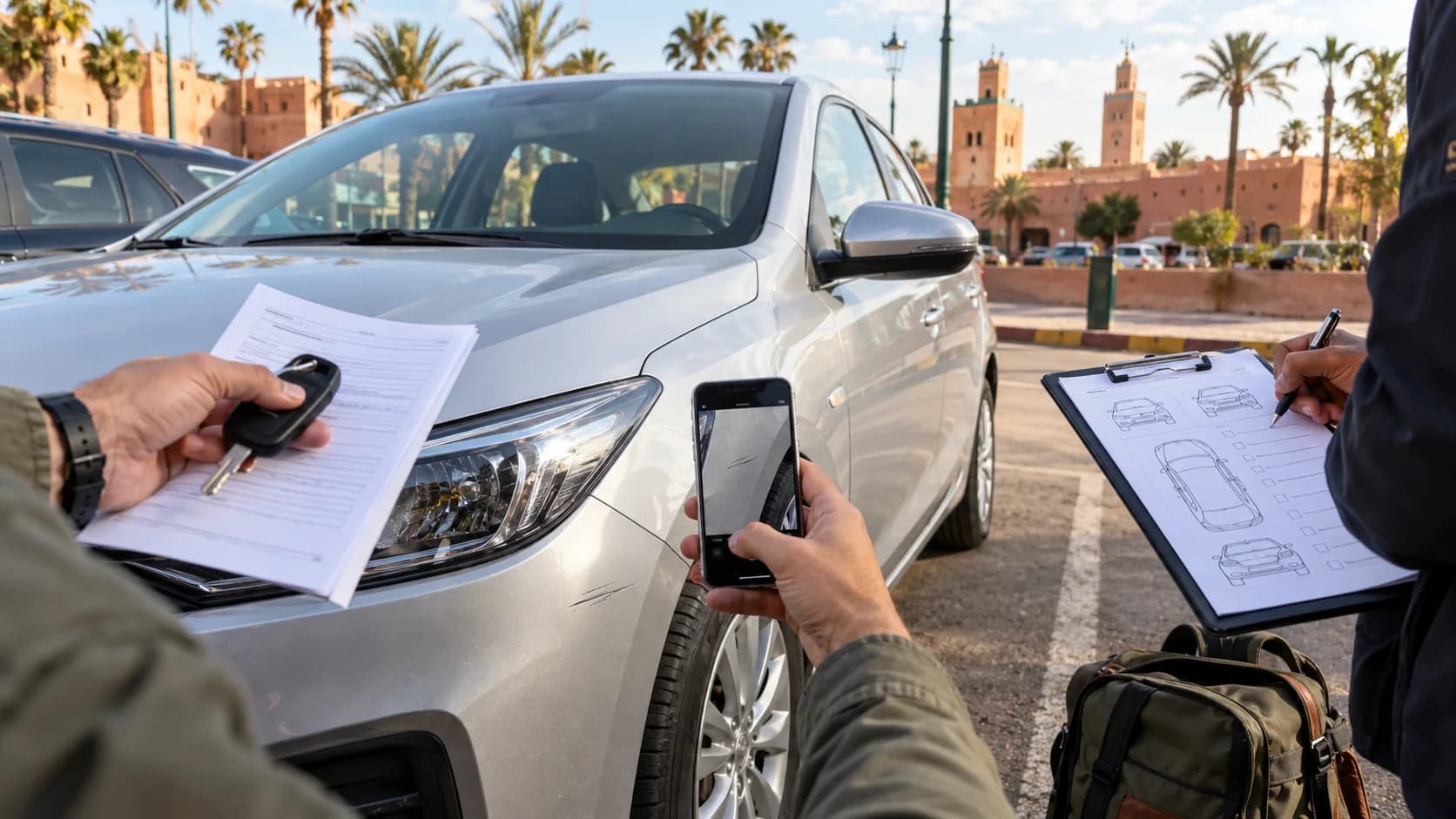
Car rental insurance in Morocco can look complicated because several different concepts are often discussed at the same time: third-party liability, Collision Damage Waiver (CDW), excess, security deposits, theft protection and optional zero-excess plans.
The most important thing to understand is that insurance coverage, excess and deposit are not the same thing.
Moroccan law requires motor vehicles to carry civil liability insurance covering qualifying damage or injury caused to third parties. Protection for damage to the rental vehicle itself, however, depends on the rental company's insurance and waiver terms, the protection plan selected and the circumstances of the incident.
This guide explains what car rental insurance in Morocco normally means, how excess works, which types of damage may be excluded and exactly what travelers should check before accepting the keys.
How Does Car Rental Insurance in Morocco Work?
Every legitimate rental vehicle in Morocco must have mandatory third-party civil liability insurance. This protects against covered injury or property damage caused to other people, but it should not be confused with protection for damage to the rental car itself.
Rental companies may also include or offer a Collision Damage Waiver or similar protection that limits how much the renter may owe for covered vehicle damage. The amount that remains your responsibility is usually called the excess or deductible.
A lower or zero excess can reduce your financial exposure, but it does not automatically mean that every type of damage is covered. Always check exclusions, reporting requirements and the exact rental agreement before driving.
Car Rental Insurance in Morocco at a Glance
| Term | What It Generally Means | What You Should Check |
|---|---|---|
| Third-party liability | Covers qualifying liability for injury or property damage caused to third parties | Confirm the vehicle is properly insured |
| CDW / damage waiver | May limit your liability for covered damage to the rental vehicle | Check the excess and exclusions |
| Excess | Maximum amount you may remain responsible for on a covered claim, subject to the contract | Ask for the exact amount |
| Deposit | Security held or collected by the rental company | Do not assume it equals the excess |
| Zero excess | Reduces the contractual excess to zero for covered damage | Check exclusions and claim requirements |
| Theft protection | Limits liability if the vehicle is stolen under covered circumstances | Check whether theft is included |
| Glass / tyres / underbody | Often subject to special exclusions or additional protection | Read the specific vehicle conditions |
| Damage report | Documentation required after an incident | Ask what report must be obtained |
For current rentals, travelers can compare MarHire car rental in Morocco and review the insurance, deposit and protection conditions attached to the selected vehicle before booking.
Table of Contents
- What insurance is legally required in Morocco?
- What does third-party liability cover?
- What is CDW?
- What is car rental excess?
- Is excess the same as a security deposit?
- What does “full insurance” mean?
- What can still be excluded?
- How does zero-excess coverage work?
- What happens if you damage the rental car?
- What should you photograph at pickup?
- Which insurance level should you choose?
- What questions should you ask before signing?
- Frequently asked questions
What Car Insurance Is Legally Required in Morocco?
Morocco requires owners of motor vehicles to carry automobile civil liability insurance, commonly called responsabilité civile automobile.
Article 120 of Morocco's Insurance Code requires civil liability arising from bodily injury or material damage caused to third parties by a motor vehicle to be insured. Morocco's insurance regulator ACAPS and the Moroccan Insurance Federation both describe this compulsory protection.
For a traveler renting a car, this means the rental vehicle should already carry the legally required liability insurance.
However, there is an important distinction:
Mandatory third-party liability is not the same as insurance for damage to the rental car.
Third-party liability primarily addresses covered losses caused to other people or their property.
If you damage the vehicle you rented, a different part of the rental agreement becomes relevant.
What Does Third-Party Liability Insurance Cover?
Third-party liability insurance generally covers qualifying:
-
bodily injury suffered by third parties;
-
damage to another vehicle;
-
damage to property belonging to another person;
-
other civil liability covered under the applicable policy and Moroccan law.
The Moroccan Insurance Federation explains that compulsory motor liability covers material damage to third-party vehicles or property and bodily damage to pedestrians, occupants of third-party vehicles and transported persons, subject to the policy and statutory rules.
It does not mean that a scratch, dent or collision damage to your rental car automatically costs you nothing.
That is where CDW, additional vehicle-damage protection and excess become important.
What Is CDW in a Morocco Car Rental?
CDW stands for Collision Damage Waiver.
Despite the word “waiver,” CDW does not necessarily remove all financial responsibility.
Instead, a rental company's CDW or equivalent protection normally limits the renter's liability for qualifying damage to the rental vehicle, provided that the renter complies with the rental agreement.
For example, imagine that:
-
covered repairs cost €2,000;
-
your applicable excess is €700.
If the claim is accepted under the protection terms, the renter's contractual liability may be limited to the applicable excess rather than the entire €2,000 repair bill.
That is only an illustration. Your actual liability depends on the vehicle, provider, protection plan, claim circumstances and rental contract.
Large Morocco rental operators themselves describe CDW as protection capable of reducing the renter's liability rather than automatically eliminating it.
CDW is not a universal product
Do not assume that “CDW” means exactly the same thing at every rental company.
One provider may offer:
-
standard CDW with a high excess;
while another offers:
-
reduced-excess protection;
-
Super CDW;
-
premium protection;
-
zero-excess protection.
The names matter less than the written conditions.
The important questions are:
What is covered?
What is excluded?
How much can I still be required to pay?
What Is Car Rental Excess in Morocco?
The excess is the amount of financial responsibility that may remain with the renter when covered damage occurs.
It is also commonly called a deductible.
Suppose your rental agreement has a €1,000 excess.
That does not necessarily mean you automatically pay €1,000 whenever anything happens.
If covered damage is assessed at €300, contractual rules may limit the charge to the applicable damage amount rather than automatically charging the full excess.
If covered damage is much more expensive, your contractual liability may be capped at the €1,000 excess, assuming all conditions for the waiver or protection are satisfied.
Hertz Morocco, for example, states that when actual damage is below the applicable excess, the lower amount is due under the relevant protection conditions.
Always rely on your own signed agreement rather than assuming this calculation works identically across every provider.
Is the Excess the Same as the Rental Car Deposit?
No.
This is one of the most common misunderstandings when renting a car in Morocco.
Excess
The excess relates to your possible liability following a covered incident.
Deposit
The deposit is security held by the rental provider during the rental.
These amounts can sometimes be similar, but they do not have to be identical.
For example:
| Item | Example |
|---|---|
| Rental cost | €250 |
| Security deposit | €500 |
| Damage excess | €1,000 |
In this example, the customer has not “paid the excess” simply because €500 is being held as a deposit.
Likewise, choosing a MarHire no-deposit rentals does not by itself tell you whether the damage excess is zero.
Always examine both numbers separately.
For a more detailed explanation, see MarHire's guide to Car Rental Deposits in Morocco: What to Expect.
What Does “Full Insurance” Mean When Renting a Car in Morocco?
Treat “full insurance” as a description that needs clarification, not as a guarantee of unlimited protection.
The phrase can describe different arrangements depending on the company.
A plan advertised as full insurance might offer:
-
reduced excess;
-
zero excess;
-
collision protection;
-
theft protection;
-
glass protection;
-
broader damage coverage.
But certain situations can still be excluded.
Before accepting any plan described as full insurance, ask:
What can I still be charged for if the vehicle is damaged?
That question is more useful than asking only whether the car has “full insurance.”
MarHire also explains the distinction in its guide to Full Insurance in Morocco: The Truth About Zero Excess.
Does Zero Excess Mean You Can Never Pay for Damage?
Not necessarily.
Zero excess usually means the contractual excess for covered damage is reduced to zero.
It does not automatically override every exclusion or every renter obligation.
For example, a rental company's protection may cease to apply if:
-
an unauthorized person was driving;
-
the driver breached the rental agreement;
-
required accident documentation was not obtained;
-
the vehicle was used in a prohibited way;
-
damage falls into an explicitly excluded category.
Some Moroccan rental-company terms also specifically exclude items such as tyres, mechanical damage, lost keys, underbody damage or other categories even from enhanced protection packages.
This is why travelers should compare coverage + excess + exclusions, not simply search for the words “zero excess.”
What Rental-Car Damage May Be Excluded From Coverage?
Exclusions differ between providers, so there is no universal list that applies to every Morocco rental.
However, categories that deserve particular attention include:
-
tyres and wheels;
-
windscreen or other glass;
-
mirrors;
-
underbody damage;
-
roof or overhead damage;
-
lost or damaged keys;
-
interior damage;
-
incorrect fueling;
-
mechanical damage caused by misuse;
-
towing or recovery outside covered circumstances;
-
off-road or prohibited-road use;
-
damage caused by an unauthorized driver.
For example, Hertz Morocco states that some optional protections do not cover overhead damage, underbody damage, mechanical or tyre damage, or lost keys and documents.
That does not mean every Moroccan rental company has identical exclusions.
It means you should specifically check these areas before relying on a general phrase such as “all-inclusive insurance.”
What Happens If You Damage a Rental Car in Morocco?
The first rule is simple:
Do not ignore the damage and do not arrange repairs yourself unless the rental company authorizes you to do so.
The correct process normally involves the following steps.
1. Make the scene safe
If the incident happens on the road, prioritize personal safety and avoid creating another hazard.
2. Contact the rental provider
Tell the company what happened as soon as reasonably possible.
Follow its accident and roadside-assistance instructions.
3. Photograph the situation
Where safe, photograph:
-
the rental vehicle;
-
the damaged area;
-
the other vehicle if applicable;
-
registration details where necessary for the claim;
-
the broader accident scene;
-
relevant road conditions.
4. Obtain the required accident documentation
Depending on the circumstances and the provider's requirements, you may need an accident report, insurer documentation, police involvement or other formal documentation.
Do not assume photographs alone are sufficient.
5. Keep the documentation
Retain:
-
accident reports;
-
rental agreement;
-
photographs;
-
correspondence;
-
repair or damage assessment documentation;
-
payment receipts.
6. Let the rental company manage repairs
Do not take the vehicle to an unofficial workshop and pay for repairs without approval.
Your protection may depend on following the contractual claims procedure.
For a dedicated step-by-step guide, see Rental Car Damage in Morocco: What Happens?.
Why Pickup Photos Matter
One of the easiest ways to reduce a later damage dispute is to document the vehicle before leaving the pickup location.
Take clear photos or video of:
-
front bumper;
-
rear bumper;
-
both sides;
-
doors;
-
wing mirrors;
-
windscreen;
-
wheels;
-
roof where practical;
-
interior;
-
dashboard and mileage;
-
fuel level.
Pay particular attention to existing:
-
scratches;
-
dents;
-
wheel marks;
-
chips;
-
cracked trim.
Make sure existing damage is recorded on the inspection sheet or acknowledged by the rental representative.
Good documentation helps distinguish pre-existing damage from damage occurring during your rental.
What Should You Check When Returning the Car?
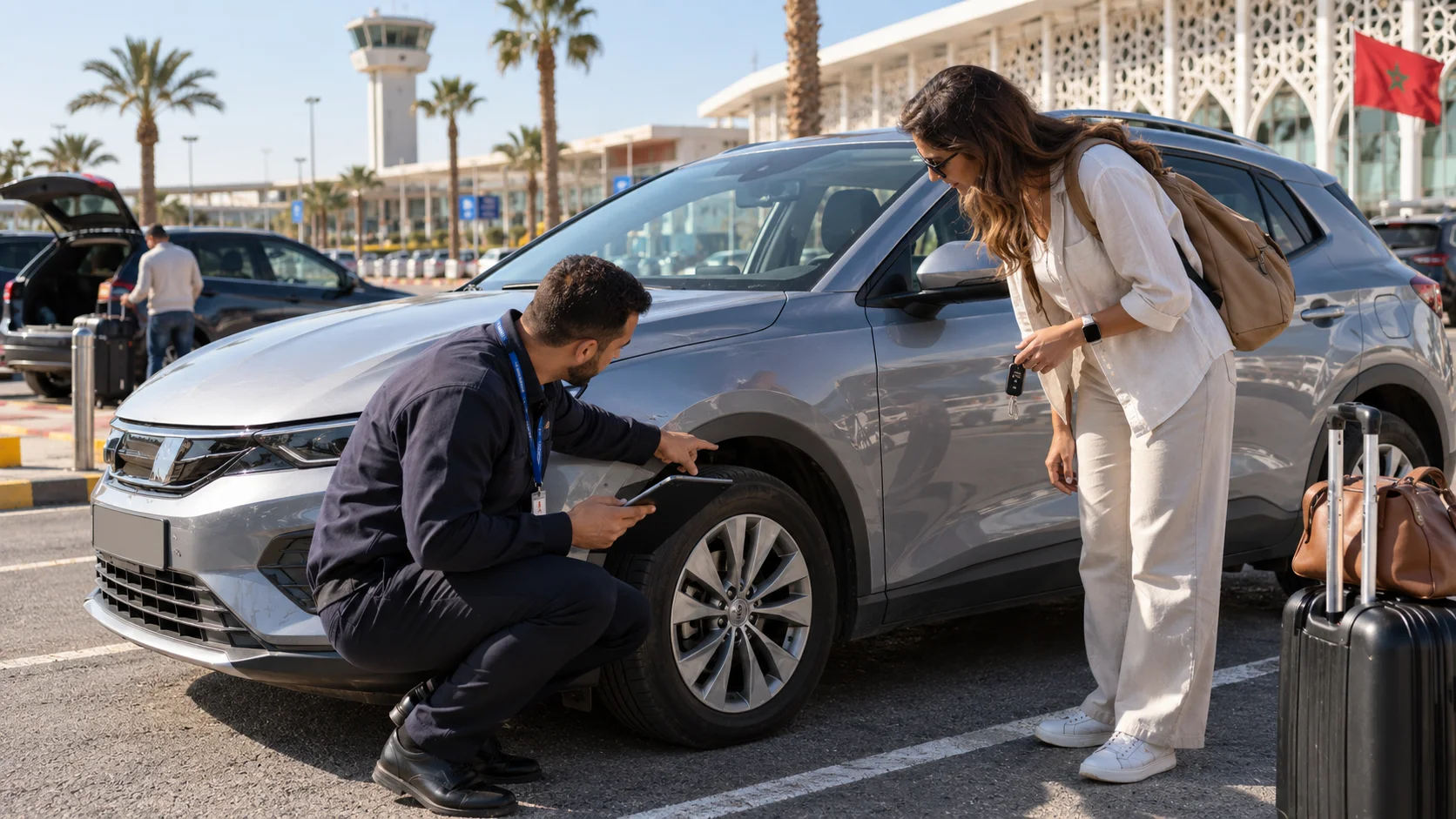
At return, perform another simple inspection.
If possible:
-
return the vehicle during the agreed return window;
-
photograph all sides again;
-
photograph the fuel level;
-
photograph the mileage;
-
have the provider inspect the vehicle;
-
ask whether any new damage has been identified;
-
retain the final rental documentation.
If the car is returned outside office hours or without an in-person inspection, understand when responsibility for the vehicle ends under the rental agreement.
How Much Can You Pay If You Damage the Car?
There is no single answer for every rental in Morocco.
Your financial responsibility can depend on:
-
repair cost;
-
protection level;
-
contractual excess;
-
type of damage;
-
whether the incident is covered;
-
whether reporting requirements were followed;
-
who was driving;
-
whether another party was responsible;
-
whether an exclusion applies.
The most useful question to ask before booking is:
What is the maximum amount I may personally owe for covered vehicle damage under this specific plan?
Then ask:
Which types of damage are outside that limit?
Together, those two questions provide much more information than simply asking whether insurance is included.
Standard, Reduced-Excess or Zero-Excess: Which Should You Choose?
There is no universal best option.
Standard protection may suit you if:
-
you accept a larger excess;
-
the deposit requirements are manageable;
-
you want to minimize the upfront rental cost;
-
you understand the financial exposure.
Reduced-excess protection may suit you if:
-
you want a balance between rental cost and liability;
-
you are planning a longer road trip;
-
paying the standard excess would significantly affect your travel budget.
Zero-excess protection may suit you if:
-
you prefer maximum predictability for covered damage;
-
you do not want a large potential damage liability;
-
the additional protection cost is reasonable for your trip.
But always check exclusions.
A €0 excess for qualifying body damage is not useful if the actual damage you suffer falls into a category excluded from the protection.
Does Vehicle Type Affect Insurance and Excess?
It can.
A small economy car and a high-value luxury vehicle do not necessarily carry the same:
-
excess;
-
deposit;
-
insurance conditions;
-
minimum driver age;
-
protection-plan availability.
Higher-value vehicles can involve different security and protection conditions because potential repair costs are higher.
When comparing MarHire cheap car rental Morocco with MarHire luxury car rental Morocco, compare the insurance conditions as carefully as the daily rental rate.
The cheapest daily price is not necessarily the lowest-risk booking.
Does Travel Insurance or Credit-Card Insurance Cover a Morocco Rental Car?
Possibly, but never assume that it does.
Some travel-insurance policies and payment cards provide rental-vehicle protection, while others:
-
exclude certain countries;
-
exclude certain vehicle types;
-
cover only the excess;
-
operate on a reimbursement basis;
-
require you to decline the rental company's optional waiver;
-
impose maximum rental periods;
-
exclude off-road use or particular causes of damage.
Before relying on third-party protection, ask your insurer or card issuer specifically:
“Does my policy cover a rental vehicle in Morocco, and is the coverage primary or reimbursement-based?”
Also confirm what documents would be needed for a claim.
A reimbursement policy can mean that you first pay the rental company and claim the amount back later.
That is very different from having the rental company's excess reduced to zero at the time of the incident.
What About Theft?
Theft protection should also be checked separately.
Do not assume that CDW automatically covers theft.
Ask:
-
Is vehicle theft covered?
-
What is the theft excess?
-
Are keys required for the claim?
-
Are personal belongings inside the vehicle covered?
-
What report is required?
Personal belongings are often a separate insurance issue from the rental vehicle itself.
Avoid leaving passports, cash, electronics or luggage visible in a parked rental car.
What If Another Driver Causes the Accident?
If another driver is responsible, liability and reimbursement may ultimately be handled differently from an at-fault accident.
However, you should still:
-
notify the rental provider;
-
collect the required documentation;
-
obtain details of the other party;
-
follow the formal reporting procedure.
Do not simply leave because the other driver says they will pay.
A rental company's terms may initially require certain amounts or documentation before responsibility is resolved. Hertz Morocco, for example, states that where the renter is entirely not liable, an applicable amount can be reimbursed once recovery is obtained from the responsible third party, subject to its conditions.
Your provider's process may differ.
Seven Questions to Ask Before Signing the Rental Agreement
Before driving away, get clear answers to these seven questions:
-
What insurance is included in my rental price?
-
What is my exact damage excess?
-
What is the security deposit, if any?
-
Which parts of the vehicle are excluded from the damage protection?
-
Is theft covered, and what is the theft excess?
-
What documentation must I obtain after an accident?
-
What situations invalidate the protection?
If the answers are unclear, ask for them in writing.
This simple checklist can prevent more problems than choosing insurance based solely on a label such as “basic,” “premium” or “full.”
Car Rental Insurance in Morocco: A Practical Example
Consider two hypothetical rentals.
Rental A
-
Daily rental price: lower
-
Deposit: €700
-
Damage excess: €1,200
-
Basic CDW
-
Several exclusions
Rental B
-
Daily rental price: slightly higher
-
No security deposit
-
Damage excess: €250
-
Broader protection
Rental A may appear cheaper in the search results.
But Rental B exposes the traveler to less potential financial liability.
Neither option is automatically better.
A traveler with sufficient funds and a high risk tolerance may prefer Rental A.
A traveler who values predictable costs may prefer Rental B.
This is why the total protection structure matters more than the headline daily rate.
Good to Know Before Driving in Morocco
Mandatory liability insurance: Moroccan motor vehicles must carry civil liability insurance covering qualifying third-party claims.
Damage protection: Check the rental agreement rather than assuming CDW is identical everywhere.
Excess: Ask for the exact amount before booking.
Deposit: Treat it separately from the insurance excess.
Zero excess: Confirm what remains excluded.
Accidents: Contact the rental provider immediately and obtain the required formal documentation.
Pickup: Photograph the complete vehicle.
Return: Repeat the photographs and keep your paperwork.
Additional drivers: Make sure anyone who may drive is properly authorized under the rental agreement.
Frequently Asked Questions
Is car rental insurance mandatory in Morocco?
Motor vehicles in Morocco are legally required to carry third-party civil liability insurance. This covers qualifying liability for bodily injury and material damage caused to third parties. Damage protection for the rental vehicle itself is governed separately by the insurance and waiver arrangements included in your rental contract.
What is the excess on a rental car in Morocco?
The excess is the portion of financial liability that can remain with the renter following covered damage. The exact amount varies by provider, vehicle category and protection plan, so check the amount stated in your booking and rental agreement.
Is CDW the same as full insurance?
No. CDW normally limits liability for qualifying vehicle damage but can leave an excess and exclusions. “Full insurance” is not a sufficiently precise description on its own; ask what is covered, excluded and what excess remains.
Is zero excess the same as no deposit?
No. Zero excess concerns liability for covered damage. No deposit concerns the security amount required at pickup. A rental can theoretically have no deposit but still have an excess, or have a deposit while offering a low or zero excess.
Are tyres and windscreens covered by Morocco rental-car insurance?
It depends on the rental company and protection plan. Some contracts exclude tyres, wheels, glass, underbody or other components from standard protection. Never assume these are covered without checking the terms.
What should I do if I scratch a rental car in Morocco?
Photograph the damage and contact the rental provider. Follow its reporting instructions and do not repair the vehicle yourself without authorization. Whether you are charged depends on the circumstances, repair cost, excess, protection level and exclusions.
Do I need a police report after a rental-car accident in Morocco?
An accident or insurer report may be required depending on the situation and rental company's claims procedure. Contact the rental provider immediately after the incident and follow its instructions regarding police, insurer or accident documentation.
Does full insurance cover every type of rental-car damage?
Not necessarily. Even enhanced or zero-excess products can contain exclusions relating to tyres, underbody damage, keys, prohibited use or failures to follow the required accident-reporting procedure. Read the policy and rental agreement rather than relying on the phrase “full insurance.”
Can my credit card cover the rental-car excess in Morocco?
Some cards provide rental-car protection, but coverage differs greatly. Confirm that Morocco, your chosen vehicle category, rental duration and type of claim are covered and determine whether the card provides direct coverage or reimbursement after you pay the rental company.
Should I choose zero-excess car rental insurance in Morocco?
Zero-excess protection can be useful when you want to minimize financial exposure for covered damage, especially if a large standard excess would be difficult to absorb. Compare the additional price with the amount of excess eliminated and carefully review remaining exclusions.
Compare Car Rental Insurance Before You Book
The safest way to compare car rental insurance in Morocco is not to look only for the words “insurance included.”
Compare:
coverage, excess, deposit, exclusions and accident-reporting requirements.
Two rental cars with the same daily price can expose you to very different financial risk.
MarHire lets travelers compare Browse MarHire car rentals across Marrakech, Casablanca, Agadir, Tangier, Fes, Rabat and Essaouira, including eligible no-deposit options and vehicle-specific protection conditions.
Before confirming any rental, check the exact insurance and excess shown for the selected car and keep those conditions with you during the trip.