






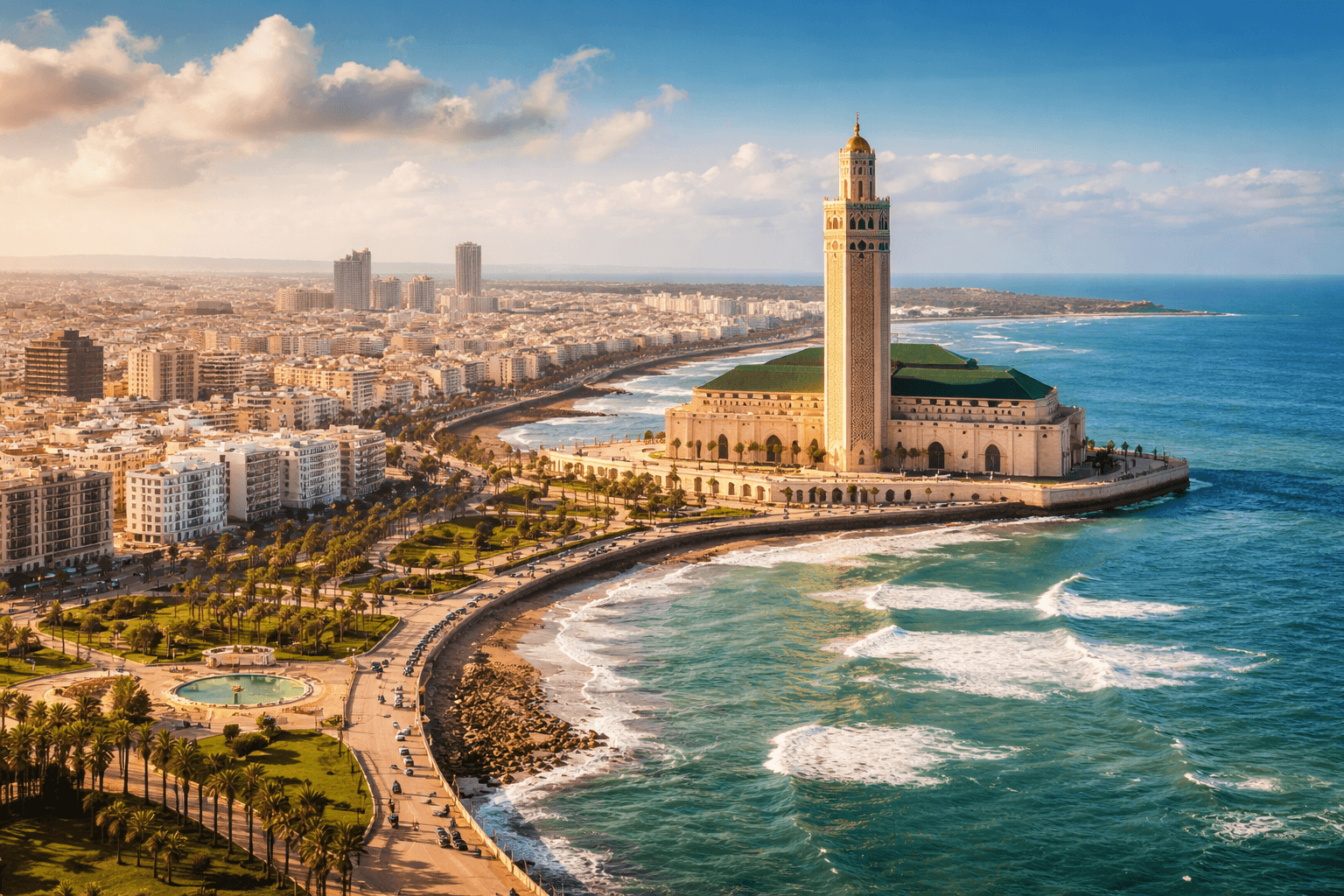
Casablanca is often treated as Morocco’s business city, the place travelers pass through on the way to somewhere “more atmospheric.” That is exactly why many people underestimate it. Yes, it is Morocco’s economic capital and one of its largest urban centers, but it is also a city of oceanfront drama, Art Deco streets, old trading history, modern districts, and one of the most spectacular religious monuments in the world: the Hassan II Mosque. Official tourism sources describe Casablanca as a metropolis where modern infrastructures sit beside medinas, Arab-Muslim heritage, and colonial-era architecture, which is what gives the city its distinct identity.
A good Casablanca travel guide should help you understand what the city does best. Casablanca is not a medina-first destination like Fes, and it is not a monument-packed imperial city like Marrakech. It works differently. It is best enjoyed through contrasts: oceanfront walks on the Corniche, coffee in the center, time in the Habous Quarter, a visit to Villa des Arts, a late afternoon near Mohammed V Square, and an evening meal by the Atlantic. That is why travelers who rush through the city often leave unimpressed, while those who give it two to five days usually discover a much richer version of Casablanca Morocco.
This guide is designed for research-stage travelers who want the practical picture: what to see, when to go, how many days to stay, whether a car is useful, where to sleep, what kind of day trips make sense, and how to build an itinerary that feels balanced rather than random. If you are arriving through Mohammed V Airport, using Casablanca as your first base in Morocco, or planning a coastal route north or south, the city makes a lot more sense when you view it as both a destination and a launch point. That is also where transport matters. Visitors who want flexibility in the city and beyond often prefer Car Rental Casablanca, while those who want easier urban logistics tend to choose Private Driver Casablanca or Airport Transfer Casablanca.
Overview and why visit Casablanca
Casablanca is worth visiting because it shows a side of Morocco that many first-time visitors do not expect. It is outward-looking, Atlantic-facing, commercially powerful, and architecturally layered. Official tourism materials describe it as the country’s economic and financial capital, a city where business districts, medinas, and heritage landmarks coexist with the rhythm of a major modern metropolis. That description feels accurate once you are on the ground. You can start the day near an Art Deco square, spend midday in a traditional quarter, and end with ocean spray beside the mosque or the Corniche.
The city’s strongest first impression usually comes from the Hassan II Mosque. Official Casablanca tourism states that its minaret rises 210 meters above the Atlantic and that it is among the few mosques in Morocco open to non-Muslims through organized visits. It is not only the city’s signature sight; it is also the landmark that reframes Casablanca for many travelers. Instead of feeling purely commercial, the city suddenly feels monumental.
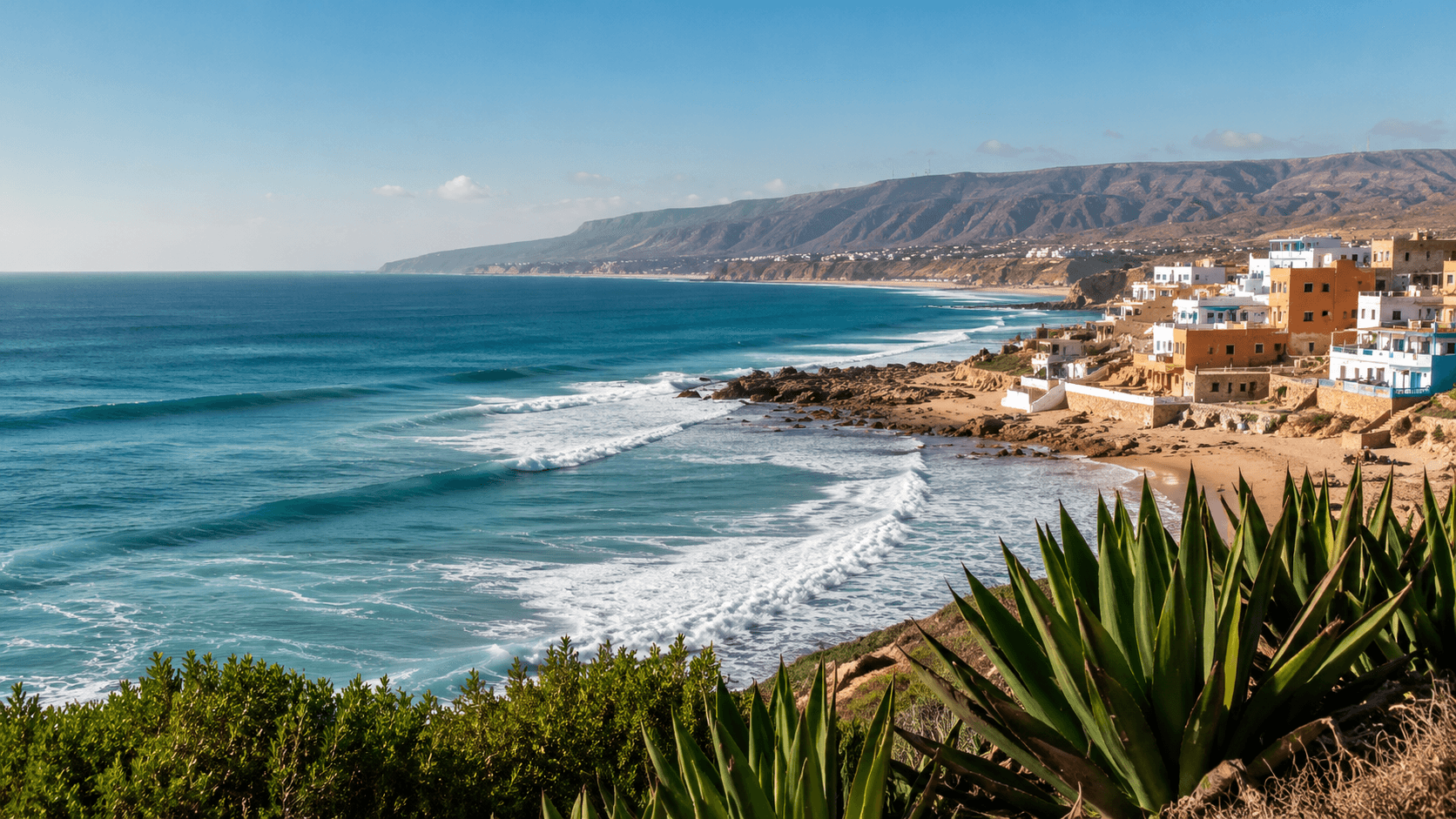
But Casablanca becomes more interesting when you move beyond the mosque. The Old Medina gives you a glimpse of the city’s earlier layers. The Habous Quarter offers a cleaner, more ordered experience of traditional urban design and shopping. Mohammed V Square reveals the French-era civic face of the city, while Villa des Arts adds a contemporary cultural note. Head west and the mood changes again: Corniche Casablanca, Ain Diab, Anfa, and the wider waterfront bring in leisure, sea views, and a more relaxed evening rhythm.
Casablanca also works well because it is practical. It is one of the easiest Moroccan cities for arrivals and departures, business-plus-leisure trips, and onward travel to Rabat, El Jadida, Mohammedia, or even longer Atlantic routes. Official Morocco tourism positions Casablanca as a bustling Atlantic metropolis, and that is exactly how to use it: not as a checklist city, but as a base with range.
For travelers who like planning with trustworthy references, two especially useful resources are the official Hassan II Mosque foundation site for visit updates and the official Morocco tourism page for Casablanca’s broader character and highlights.
Best time to visit Casablanca
Casablanca is easier year-round than many inland Moroccan cities because of its Atlantic position. Official Morocco tourism notes that the country’s coastal regions enjoy sunshine across the year with milder conditions than the interior, which helps explain why Casablanca can work in every season if your expectations are right.
For most travelers, the best time to visit is spring and autumn. These months usually give you the best mix of mild walking weather, comfortable waterfront time, and easy city exploring without the heavier holiday-season traffic or the stronger summer beach crowds. Casablanca does not usually create the same heat-management issues as Marrakech or inland southern destinations, which makes it a good urban choice for travelers who still want Morocco without structuring every afternoon around avoiding peak heat.
Summer is still a good option, especially if you like the Corniche, beach clubs, and later evenings by the ocean. Winter can also be very pleasant for architecture, museums, and city walking, though it is less of a beach atmosphere and more of an urban, Atlantic one. The main thing to understand is that Casablanca is not a city you visit only for one perfect weather window. It is a flexible year-round stop, with seasonal mood changes rather than hard limits.
If your trip overlaps Ramadan or a religious holiday, check the Hassan II Mosque foundation site before planning your visit, because special schedules are published there. In February 2026, for example, the foundation posted dedicated Ramadan visiting hours for non-Muslim visitors.
Top 8 attractions in Casablanca
1. Hassan II Mosque
This is the essential Casablanca attraction. Official city tourism describes it as the tallest minaret in the world at 210 meters and one of only two mosques in Morocco open to non-Muslims. Beyond the scale, the location is part of the experience: the building rises directly above the Atlantic, which gives it a drama that photographs cannot fully capture. It is the obvious headline sight, but it earns that status.
2. Corniche Casablanca and Ain Diab
If the mosque is Casablanca’s monumental face, the Corniche is its leisure side. This is where the city opens toward the ocean through promenades, restaurants, beach clubs, and sea-facing places to linger. Nearby Anfa Place also anchors the area as a modern waterfront shopping and dining point on Ain Diab Corniche Boulevard.
3. Old Medina
The Old Medina is not Morocco’s most elaborate medina, but it matters because it shows Casablanca’s older urban core. Official Visit Casablanca materials place it between major boulevards near La Sqala and Rick’s Café, and describe it as the historic heart corresponding to original Anfa. That makes it a good stop for context rather than just shopping.
4. Habous Quarter
Habous, often called the New Medina, is one of the city’s most visitor-friendly quarters. Official Casablanca tourism presents it as part of a curated cultural circuit where architecture, daily life, and local flavor come together. It is a strong place for bookshops, pastries, ceramics, and a more orderly experience than the older medina.
5. Mohammed V Square
This square is one of the best places to feel Casablanca’s civic center. It reflects the city’s administrative and French-era urban identity and works well as part of a central walking route with nearby Art Deco streets. While not flashy, it helps explain how Casablanca became the city it is today.
6. Villa des Arts
Villa des Arts adds something many visitors do not expect from Casablanca: a clean, contemporary cultural stop in a 1930s Art Deco villa. The institution’s own site presents it as a space dedicated to contemporary art and the promotion of Moroccan artistic heritage, which makes it a useful counterpoint to the city’s religious and historical landmarks.
7. Anfa neighborhood
Anfa represents upscale residential Casablanca and the city’s more modern, refined side. Nearby places such as Anfa Park and hotels along Boulevard d’Anfa make this zone useful for travelers who want a less hectic base with easier car movement than the old core.
8. Rick’s Café
Rick’s Café is not important because it is ancient; it is important because it speaks to Casablanca’s myth. Official Visit Casablanca describes it as a place that recreates the atmosphere associated with the famous film and positions it as one of the city’s iconic venues for lunch, dinner, or drinks. Even travelers who do not build their evening around it usually recognize it as part of the city’s legend.
Recommended car types
Choosing the right vehicle in Casablanca depends on how you plan to use the city. If your stay is mostly urban, with a hotel in the center, Corniche, or Anfa, and only one or two short excursions, a compact automatic is usually the smartest choice. Casablanca traffic is not impossible, but smaller cars are easier to park, easier to place on tighter streets, and less tiring in dense areas.
If you are landing at the airport with luggage, staying outside the center, or planning a wider Casablanca itinerary that includes Rabat, Mohammedia, or El Jadida, a compact SUV or crossover often makes more sense. You get easier luggage loading, slightly higher seating, and more comfort on longer coastal drives. For families, that extra space matters.
For groups, business travelers, or people who simply do not want to deal with urban parking and local traffic rhythm, the better choice is often not a bigger car but a driver. That is where Private Driver Casablanca becomes more practical than self-drive. Meanwhile, travelers arriving late, carrying lots of bags, or heading directly from the airport to a hotel usually appreciate the simplicity of Airport Transfer Casablanca. If your trip includes multiple stops outside the city, Car Rental Casablanca gives the most flexibility.
Driving tips and safety
Driving in Casablanca is manageable, but it is a big-city experience, not a resort-town one. The main challenge is rhythm: lanes fill quickly, taxis stop suddenly, scooters appear fast, and certain roundabouts and junctions require more patience than assertiveness. This is not a city for rushed, reactive driving.
The easiest way to make Casablanca driving feel simple is to avoid forcing the car into the wrong parts of your day. If you are doing the Old Medina, Mohammed V Square, Habous, or a meal where parking is awkward, think ahead. A car is most useful between zones, for hotel access, for coastal movement, and for leaving the city. It is least enjoyable when you are trying to improvise parking in dense central areas.
The Corniche and Anfa side are generally more straightforward than older central pockets, especially if you are staying near broad avenues. If you are new to Morocco, avoid treating your first hour after pickup as a test of confidence. Start with a simple route, use daytime if possible, and build from there.
For many visitors, the ideal split is this: use Airport Transfer Casablanca on arrival if landing tired, keep Car Rental Casablanca for the days when you need range, and use Private Driver Casablanca when your schedule is city-heavy or meeting-based. That approach usually feels easier than forcing one transport mode onto every day.
3-day Casablanca itinerary
Day 1: Monument and coast
Start with the Hassan II Mosque in the morning, ideally building your day around an official visit slot if you want to go inside. After that, stay on the ocean side of the city. Walk the seafront, have lunch toward Ain Diab, and spend the late afternoon around the Corniche. End with dinner by the water. This first day works because it gives Casablanca’s strongest first impression: scale, light, ocean, and open space.
Day 2: Historic and civic Casablanca
Spend the morning in the Old Medina, then continue toward Rick’s Café, La Sqala area, and the center. In the afternoon, move into Mohammed V Square and the surrounding urban core. This is the day that explains the city, because it brings together old Casablanca, colonial-era planning, and the modern administrative face.
Day 3: Habous, art, and modern neighborhoods
Begin in the Habous Quarter for browsing and a slower morning. Then head to Villa des Arts for a cultural stop that breaks up the trip nicely. If you still have time, continue toward Anfa or the Corniche again for a more polished, modern Casablanca finish. Travelers who want shopping or a softer urban day can also use Anfa Place as part of this route.
This three-day version is enough for most travelers who want a satisfying city break without turning Casablanca into a rushed stopover.
5-day Atlantic Coast itinerary
Day 1: Casablanca core
Use your first day for the Hassan II Mosque and a waterfront evening. Keep it light if arriving from the airport.
Day 2: Casablanca districts
Build around Old Medina, Mohammed V Square, Habous, and Villa des Arts. This is your city-understanding day.
Day 3: Rabat day trip
Rabat is one of the easiest and most worthwhile trips from Casablanca. Official Morocco tourism presents Rabat as a cultural capital with monuments, museums, green spaces, and Atlantic coastline, making it a strong contrast to Casablanca’s commercial identity. It works especially well as a same-day return.
Day 4: Mohammedia or relaxed coast day
Official Visit Casablanca describes Mohammedia as a coastal city only about twenty kilometers from Casablanca, known for its beaches and calmer atmosphere. That makes it a good lighter outing if you want sea air without a full long-drive day.
Day 5: El Jadida
If you want a longer Atlantic extension, El Jadida is the best choice. Official Morocco tourism presents it as a former Portuguese city with preserved architecture, beaches, and UNESCO-recognized heritage. It gives your itinerary a very different coastal-historic feel from Casablanca itself.
This five-day version is ideal for travelers who want to use Casablanca not just as a city break, but as the hub of a short Atlantic Morocco route. It is especially practical with Car Rental Casablanca, though travelers who want maximum ease can keep Private Driver Casablanca for the longer day trips.
Best restaurants and hotels
Casablanca’s food and hotel scene reflects the city itself: more modern, more business-friendly, and more varied by district than many first-time visitors expect.
For restaurants, Rick’s Café is the most famous symbolic choice, and official Casablanca tourism highlights it as a legendary venue open for lunch, dinner, and drinks, often with live music. It is not just about the menu; it is about atmosphere and story.
For a classic local stop in the center, the Marché Central area is useful because it connects everyday Casablanca with lunch options and city movement. Official Visit Casablanca lists the market as a core point in the city center with regular opening hours, and it works well for travelers who want something less polished and more rooted in daily city life.
If you prefer seafront or modern dining, the Corniche and Anfa Place zone is usually the safest bet. Official Casablanca tourism identifies Anfa Place as a major mixed-use waterfront shopping and food area on Ain Diab Corniche Boulevard, which makes it useful for easy meals, group dinners, or a simple evening after sightseeing.
On hotels, area matters as much as brand. Travelers who want quick access to the mosque, old center, and business districts often do well near Boulevard d’Anfa or the Tour Blanche area. Official Visit Casablanca notes that Sofitel Casablanca Tour Blanche is a short walk from the medina and minutes from Hassan II Mosque, while Barcelo Anfa Casablanca is close to the old medina and a few minutes from the mosque.
For travelers who want ocean views and a central position, official Casablanca tourism highlights Idou Anfa for panoramic views of the ocean and mosque. This kind of location works well if you want a balance between city access and a more open feeling.
If you want a more business-friendly or polished modern stay, the Anfa and center zones are usually stronger than the older quarters. If you want atmosphere and walkability to older Casablanca, staying closer to the medina side can be more rewarding. If you want late dinners, waterfront time, and a less administrative feel, the Corniche side is often the nicest choice.
A simple rule helps:
-
Stay near the center or Boulevard d’Anfa for balanced city access.
-
Stay near the Corniche for ocean mood and evenings out.
-
Stay close to the old core if your priority is history, atmosphere, and shorter sightseeing hops.
Day trips from Casablanca
Casablanca’s day-trip strength is one of its biggest advantages.
Rabat is the easiest high-value option. Official Morocco tourism presents it as a capital city of monuments, coastline, parks, and culture, making it the best first pick if you want one day outside Casablanca.
Mohammedia is the gentle option. Official Visit Casablanca describes it as a nearby coastal city with beaches and a calmer atmosphere, which makes it perfect when you want a half-step away from the city rather than a full excursion.
El Jadida is the more heritage-focused coastal day. Official Morocco tourism highlights its Portuguese legacy, beaches, and UNESCO-recognized architecture, making it a rewarding southbound outing.
These are the trips where transport matters most. If you want to stop, explore at your own pace, or combine places, Car Rental Casablanca is usually best. If you want a smoother full-day experience with less mental load, Private Driver Casablanca is often the better option.
FAQ
1. Is Casablanca worth visiting in Morocco?
Yes. Casablanca offers a different side of Morocco: oceanfront energy, major architecture, modern districts, civic squares, and easy access to other Atlantic destinations.
2. How many days do you need in Casablanca?
Two to three days is enough for the city itself. Five days works well if you want to include Rabat, Mohammedia, or El Jadida.
3. What are the best things to do in Casablanca?
The essentials are Hassan II Mosque, Corniche Casablanca, the Old Medina, Habous Quarter, Mohammed V Square, Villa des Arts, Anfa, and Rick’s Café.
4. Is Hassan II Mosque open to non-Muslim visitors?
Yes. Official tourism information states that it is one of the only mosques in Morocco open to non-Muslims through organized visits.
5. What is the best time to visit Casablanca?
Spring and autumn are usually the easiest seasons, but Casablanca works year-round thanks to its Atlantic climate.
6. Do you need a car in Casablanca?
Not always. A car helps most for airport runs, outer districts, and day trips. For city-heavy schedules, a driver can be easier.
7. Is driving in Casablanca difficult?
It is manageable, but dense. The main challenge is big-city traffic rhythm, not bad roads.
8. What area should I stay in Casablanca?
Stay near the center or Boulevard d’Anfa for convenience, near the Corniche for ocean atmosphere, and near the old core for history-focused sightseeing.
9. What is the best day trip from Casablanca?
Rabat is usually the best all-round day trip, while El Jadida is strongest for a heritage-and-coast mix.
10. Is Casablanca just a stopover city?
No. It can be a stopover, but travelers who give it structure usually find it rewarding as a proper destination.
Book with MarHire CTA
Casablanca is easiest when your transport matches your trip style. If you want freedom for the Corniche, Anfa, business meetings, and Atlantic day trips, Car Rental Casablanca gives you flexibility. If you want the city without the parking, traffic, and navigation effort, Private Driver Casablanca keeps the experience smoother. And if you are arriving through Mohammed V Airport and want the simplest possible start, Airport Transfer Casablanca is the practical choice.